WARNING!!!! THIS POST CONTAINS SPOILERS FOR FRANKENSTEIN. PROCEED AT YOUR OWN RISK!!!
Last night, a group of my colleagues and I went out, and one of them had seen Frankenstein, which meant I could wax poetic about it without spoiling. I mentioned something I alluded to in my last post, that Elizabeth’s interactions with The Creature were not romantic, but motherly. My coworker asked me to explain.
I’m going to double down on this, so stay with me. This post is an expanded version of my argument.
First, in Mary Shelley’s book, Victor and Elizabeth are the couple. William is just a child, and baby brother Ernest isn’t even in the movie at all. Elizabeth Lavenza is an Italian orphan Caroline Frankenstein plucks like a puppy from a foster home and raises with the children. Victor is basically marrying his non-related stepsister, which is somewhat less incestuous than what other noble families were doing. Making William an adult with an unrelated fiancé allowed del Toro to introduce Harlander, who is so much fun we don’t care that he wasn’t in the novel.
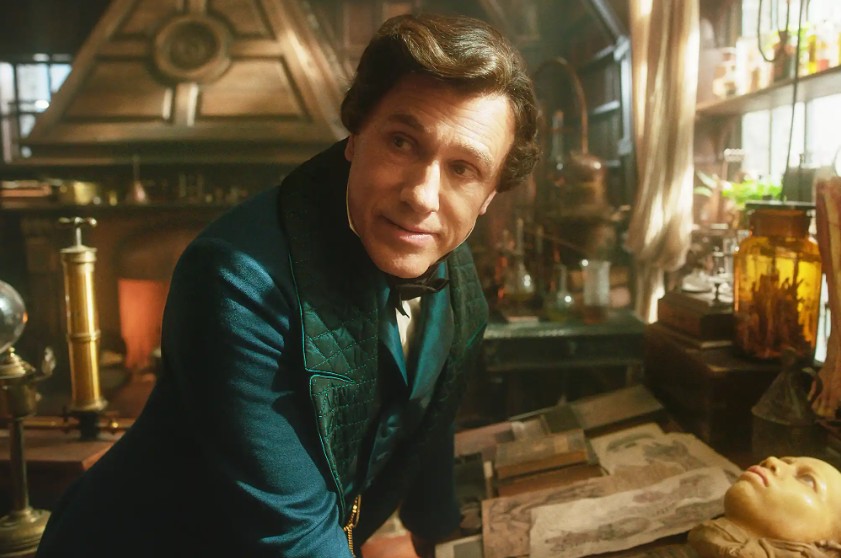
Image: via Entertainment Weekly – Ken Woroner/Netflix
Their flirtation in the film alludes to their relationship in the book. If it had been preserved in the film, Elizabeth would have been The Creature’s de facto stepmother. Watching them play with each other, you get the impression that if she weren’t already taken, Elizabeth might very well decide to accept Victor – but it would be on her own terms.
Second, del Toro’s dual casting of Mia Goth as Claire Frankenstein, Victor’s mother, and Elizabeth Harlander, is significant. I can’t remember in which article I read it, but del Toro said straight out that some men marry their mothers. Victor certainly has a fixation on his.
del Toro also uses color in his films very deliberately. The dynamics are reflected in Kate Hawley’s costume designs. Claire’s clothing is all red. Victor wears red too (gloves, a scarf, a coat). Elizabeth’s primary color is green and/or teal, but around her neck is an ever-present rosary. What color is it? Red. When she visits Victor and sees the dissection, she is wearing red, and for a moment . . . but no, sorry Victor, you weren’t the chosen one.
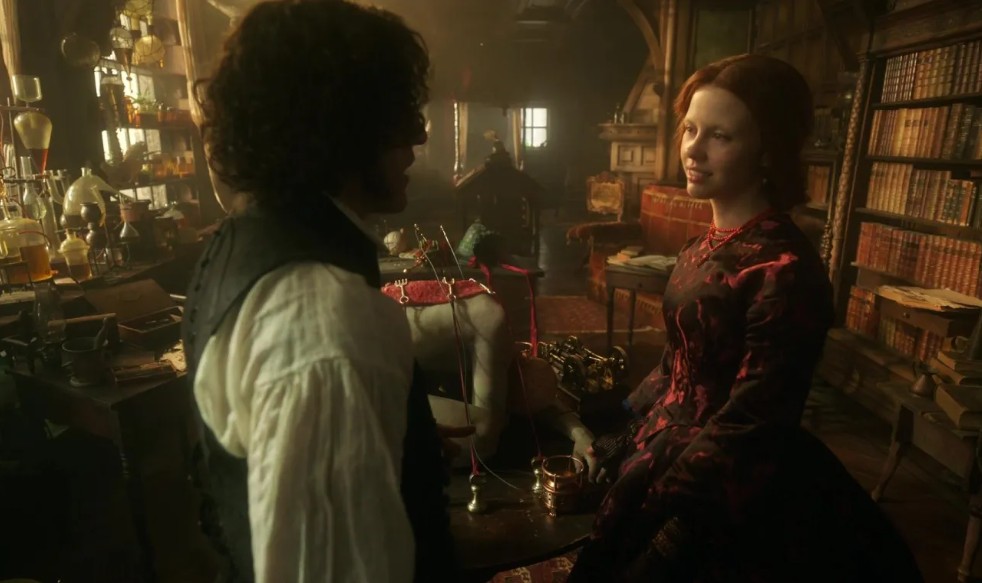
Image: Netflix
Elizabeth’s first glimpse of The Creature is shocking. She sees a man in chains, with terrible wounds all over his body. He’s clearly different from anyone she’s ever beheld. She responds to his vulnerability and pain—her first words to him are, “Who hurt you?”
When she returns shortly with William and Victor, it’s clear that Victor is not taking care of this child. He calls him “it” and says the chains are for his own protection and The Creature’s, because “He doesn’t know any better.” Just like a baby.
And he is, at first—scared of the sun, grabbing the razor like a curious baby, rattling the chains Victor puts on him like it’s a game, and playing with the water in the basement sluice like a baby in the bath. Victor tells Anderson, “Everything was new to him.”
On her third visit, alone this time, Elizabeth relates to him as though he’s a small child. He gives her a leaf, and she responds, “A leaf? For me? Thank you!” Her tone is that of a mother thanking a three-year-old for giving her a flower. She continues in that tone when teaching him her name.
Then, when she goes upstairs, Victor is there, lounging with his robe half open . . . looking all sensual . . . what was I saying again? Oh right!
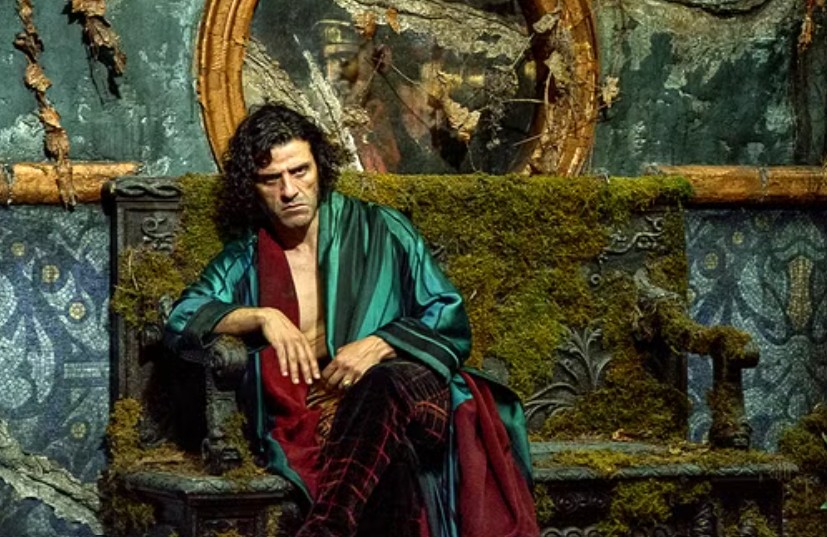
Image: Netflix
Victor is oriented to the flesh. His research centers around the body, and he’s very grounded in sensuality and his attraction for Elizabeth. Of course the first thing this man would think is that Elizabeth is attracted to The Creature. It’s pure projection on his part. And he’s jealous. She’s not tiptoeing around the tower in a nightie to visit him.
Elizabeth’s nature is of the spirit – she’s very pious despite her interest in science. The dissection reminds her of a “martyrdom painting,” i.e., religious art, and she sees God in the symmetrical structure of the spinal column. She just came out of a convent to marry William. Young Catholic women were often sent to convents to strengthen their religious education because Catholic schools were not legal at certain points in English history, and they would someday be guiding their children in the faith. The families paid the convents for boarding them, which helped keep them afloat.
When Victor accuses her of basically wanting to bang his boy, she says no very emphatically. She talks about purity of soul, that God may have breathed directly into the flesh Victor animated, etc. During the updated Victorian period in which del Toro set the film, twenty years into Queen Victoria’s reign, children were still seen as exploitable resources. It wasn’t until later that childhood began to be revered, and they gained status as people in their own right. Elizabeth, who has already expressed progressive views, is ahead of her time in seeing the innocence and purity of this unusual child.
The Creature looks very newborn and angelic in their previous scene as well – he’s bald, his skin is pale and glowing, and his expression is one of wonder and curiosity. If Elizabeth had lived and had children with William, I think she would have viewed her babies the same way.
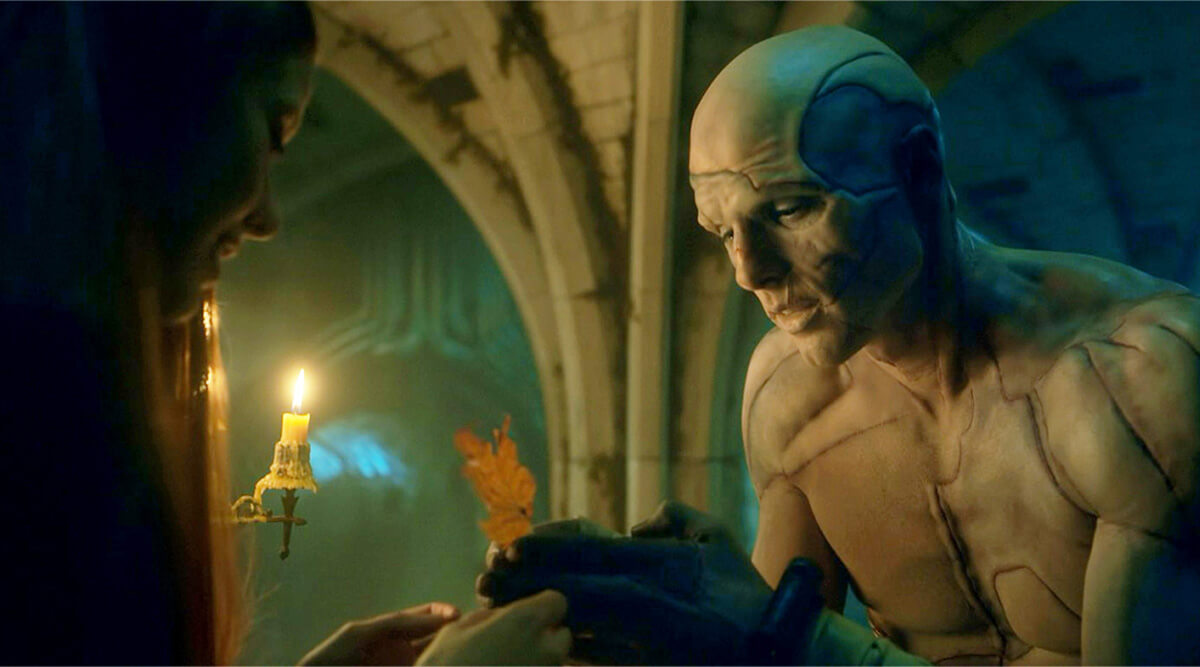
Image: Netflix
At her death, Elizabeth tells The Creature (I hate calling him that; his name would be Adam if Victor had even bothered) she realizes that she didn’t belong in the world. She was looking for something more elevated, and she found it with him. Not as a lover, but as pureness of soul, something finer than the earthly. Their connection hinges on seeing that in each other—he is untouched by the world, and to him, she’s just love. She’s the only person who ever treated him kindly except for the blind grandfather. It’s selfless like the love of his only friend, a maternal, caring love.
del Toro has been obsessed with this story for decades. There are references throughout the film to both the book and other adaptations. Victor and Elizabeth being a couple (novel) and the dual roles (Elsa Lanchester played Mary Shelley in The Bride of Frankenstein as well as the female creature), The Creature’s long stringy hair (novel) and his oversized, shapeless coat (Charles Ogle as The Creature in Thomas Edison’s 1910 silent film—watch it here), and too many others to mention. And good for you if you spotted that the sleeves of Elizabeth’s wedding dress look like the bandages on Elsa Lanchester’s arms in Bride. A nod is not an interpretation, however, and love is not confined to the romantic sphere.
If you want to read the book, it’s in the public domain. You can download it for free at Project Gutenberg here: Frankenstein by Mary Wollstonecraft (Godwin) Shelley


 Graphomaniac - A. Elizabeth West