A Positive 9/11

Today, September 11, 2010, is the ninth anniversary of the terrorist attacks on the World Trade Center in New York City, USA.

For my readers across the world, I thank you for the support you lent to stranded Americans the day of the disaster who were unable to get home.  I thank all people in countries other than mine who sympathized with us, cried for us and prayed for us.  Some of you know what terrorism is like on a daily basis; for us it was an ugly and shocking wake-up call.

The aim of terrorists is not to kill, but to demoralize by using fear.  Each person who shows kindness and tolerance to those not of their race, creed or culture takes a step to eliminate terrorism.  If we become fearful or angry because of someone’s color, clothing, sexual orientation or religion, the terrorists win.  When we talk about burning another faith’s holy book, we fall directly into their hands.

Despite what some people would have you believe, Islam is not an evil religion, nor does it preach hate.  God does not hate gays (there are gay animals–look it up) and you should not either.

Do not use the Lord God to condemn others because they are not like you.  Black, white, gay, straight, young, old, we are all human.  We are the same more than we are different.  We all want enough to eat, a safe place to sleep and to be with our loved ones.  We all bleed red when we are cut.

Any time you hurt someone because of hate, YOU are the terrorist.

Today, do something that will crush hate.  If you don’t know how, try one of these suggestions.

  • Embrace someone you never thought you would.
  • Learn something about another culture or creed.
  • Educate yourself on a subject you don’t understand.
  • Speak with someone different from you and find common ground.
  • Thank a service member, a firefighter or a police officer for all they do to protect and help others.
  • Smile at someone who seems to need it.

The goal is not to win; it is to bring everyone together.  Only then will fear and hatred recede. Do not feed them.  Starve them with your openness and generosity.  The world needs you for this purpose.

Be a friend, not an enemy.  Be human.

Insight

Someone told me off recently.  Big time.  I think I mostly deserved it.  It brought to mind two things writers would do well to think about.

The first is image. We have a mental image of ourselves:  how we look, our behavior, how we sound, what other people notice about us.  Very often we’re wrong.  We tend to think of ourselves as better than we are, more generous, justified in our rage, and that our drama matters.

Truth?  No.  one.  cares.

You may be a consummate professional, always polite and well-coiffed and perfectly groomed all day long, always doing and saying the right thing.  I’m not you.  I’m a creative person and very loosey-goosey and will never be a tight, buttoned-up corporate type.  Neither can you do what I do, or be me.

That doesn’t mean I can’t think of you with respect and treat you accordingly, whether you are my brother, my sister, my boyfriend, my girlfriend, my boss or the person who bags my groceries.  It doesn’t mean that if you are disrespectful to me that I owe you a harsh word, either.

In the Internet age, everything you write and say in interviews and video of you and things people say about you are out there forever.  People who don’t know you will be buying your books, your art or seeing movies you wrote or acted in.  They will base their opinion of you on whether they like your work, but also on what other people are saying about you.

That leads me to the second, insight, and the title of this post. We know when we’ve done wrong.  We should, anyway.  I think today a lot of people have forgotten what shame feels like.  It’s a nasty feeling to think that you are not the kind of person you thought, or that others don’t like you.  It’s easy to take that and run have a pity party with it, but that’s not productive, nor is it correct.

A mistake is a learning opportunity.  How did it happen?  Why is someone angry with you?  Did you act without thinking?  What we do affects others, and we don’t always realize that right away, but the reaction we get can tell us much.

I accidentally cut someone off in traffic one day and waved a big “Sorry” at them.  They still honked and flipped me the bird.  Fine, if you feel that way.  I didn’t mean to.  But if ticking you off made me more aware of my lane changes, then I’ve learned something.

If someone tells me something about myself that I need to hear, it might make me feel like the ass end of a snapping turtle.  Can I grow from it?  HELL YES.  If I allow it.

Writers deal with rejection and criticism all the time.  I could easily take my rejections personally and never submit or query again.  Will I be a writer this way?  Yes, but never a paid one.  If I analyze my mistakes and see where I went wrong, my next query or article or book will be better.  If I’m rejected because of my attitude, then I only have myself to blame and I’ll never make it.  Same in life; who’s going to want to spend five minutes with me if I’m a complete bitch?

You can’t control what other people do.  You can control your temper—if you choose to—and you can control what you let yourself take from rejections, mistakes and your own choices.

If you have a poor image, writer or not, maybe it’s time to get to work on it.  You won’t have to worry about hiding anything if you clean up your mess and what’s more, if you own it.

My friend David said on Facebook, “I follow the 80/20 rule. If eighty percent of the time you’re a sweetheart, then who cares about the twenty percent when you’re less than perfect?  But if the eighty percent is cranky/bitter, then time to shop for new friends.”

My reply?  “If you are an eighty-percenter, time to get your head out yer ass!”  Or time to take my own advice.

Interview: Chuck Sambuchino’s How to Survive a Garden Gnome Attack

There’s a new book coming out September 7 that I am dying to read.  The cover looks like this:

I think he's looking at me...

The author is a favorite blogger of mine, Chuck Sambuchino.  He’s been a wealth of information for all us UNPUBs out there.   I found him through Writer’s Digest and never looked back.

Chuck looks like this:

Gnome defense expert and publishing advice giver. Top that, Van Damme!

In his own words:

Chuck Sambuchino is the author of HOW TO SURVIVE A GARDEN GNOME ATTACK, a humor book coming out Sept. 7, 2010.  He is also the editor of GUIDE TO LITERARY AGENTS (2011 edition in stores August 2010) and runs a large blog on publishing: www.guidetoliteraryagents.com/blog.  Besides that, he is a magazine freelancer, playwright, husband, owner of a flabby dog, cover band guitarist, and all around chocolate chip cookie fiend.

Anyone who likes chocolate chip cookies can’t be all bad.  Chuck was gracious enough to grant an interview to this blog.

Tell us about the book.  The cover is hilarious.  It looks like a spoof of the 1976 book Gnomes, by Wil Hugyen and illustrated by Rien Poorvliet.  I loved that as a child.  Is this a gritty reboot?  Were you attacked by a gnome?  Should I rethink buying a gnome statue for my garden?

The cover is a spoof of the old book—good catch.  It’s not a reboot as much as something else entirely.  But yes, I would rethink that gnome purchase if you want to stay alive.


Humor writing is not easy for a lot of people.  Funny is very subjective.  Do you have any tips for writers who might like to do this type of work?

Obviously, the concept of the book is key—but there needs to be good content in the book, as well. My editor said it well when she said that people will pick up the book because of the title and cover, but they will only buy it if they flip through some pages and are impressed.  Besides that, I would try to build a platform and network of friends any way you can.  With the big publishing blog I handle (guidetoliteraryagents.com/blog), I have developed a decent platform to reach readers.  It isn’t necessarily a “humor platform,” per se, but it is a platform of some kind.

Your blog contains a great deal of information for new writers.  We thank you profusely for the help you’ve given us. Working in the business yourself, you’ve undoubtedly been well-prepared for publishing your own book, but is there anything that surprised you about the process?

Several small things. For example, a large portion of the original text ended up on the cutting room floor to make room for lots of photos—that part surprised me, but the end result is better for it. A surprising thing for me was how quickly the book came to life.  The publishing industry moves sooooo slow, but this book went from initial discussions with the editor to being published in 10 months, and that’s lightning.  I am very fortunate for that.

Marketing is getting pretty important for writers. Any hints for novelists in particular on their platforms and establishing a presence?

Bribe TV anchors to interview you and get involved in some kind of political scandal.  Besides that: Become involved in writers groups and organizations.  Join a local group, the MWA, the RWA, SCBWI—whatever you like.  And you can always develop a platform that has nothing to do with your writing.  For example, if you start a popular blog on yoga, when you have a novel to sell two years from now, you will have some kind of platform in place to read people who may buy the book.  You need friends who will help you spread the word in their small circles just as you will do for them.

Money is seriously lacking in every industry these days.  Advances are shrinking, editors are being laid off and it’s harder than ever to even get a manuscript past the round file.  Can a fiction writer really make a living anymore?

Well, it’s not likely if all you want to do is sell fiction.  A successful writer needs to wear many different hats—they need to write fiction, teach classes, write articles and freelance edit.  You need to remember that it’s OK to write some things for love and other things for money.  David Morrell, a popular thriller writer, once told me that only 250 people make their living solely from writing fiction.  You have to do other things to pay the bills.  But yes, you can make it work and make a full-time living writing.

What do you see for the future of publishing?

Not sure.  My specialty is helping people get their work published and finding an agent.  As far as the looming transition to e-books and such, I’m already kind of burnt out on people taking wild guesses on all that, and any guess I take would be beyond wild.  (Note to self: Write novel and title it Beyond the Wild.)

Just for fun, what’s the weirdest question / comment you’ve ever come across on your blog?

Following an agent interview, I do remember one comment that was something along the lines of “If this agent can’t sell books, she should model in Playboy because she’s that beautiful.” I think it was about 20 minutes later that the agent frantically e-mailed me to ask me to remove the comment.

Thank you, Chuck!  Everyone, get thee to a bookstore or Amazon and buy this book.  It looks like a hoot.  God knows we all could use a laugh these days!

Inspiration: “Where do you get your ideas?

If you’re a writer or artist who works strictly from your imagination, someone’s probably asked you the title question already, or they will.  When you’re rich and famous (ha!), some version of it will be standard.

The answers are as different as the writers asked.  Each person finds inspiration in varying places, at different times, in wide-ranging ways.  Nearly anything can spark an idea—an overheard conversation, a lovely (or ugly) view, something your kid just did that made you laugh.

What will you say when they ask you?  It might be one of these:

Nature

Beethoven often took insanely long walks around Vienna.  He loved being outside.  He would use the time to think and plan his music.   His walks inspired at least one symphony devoted to rural life, No. 6, the Pastoral. You may remember it from Disney’s Fantasia as the music from the centaur cartoon.

Take a walk outside.  What do you see?  Are there smells?  Of course there are.  What is that scent?  How about that sound?  Can you identify it without looking?  Exercise your body and your senses as well.  An element you perceive may not be a story element in itself.  It could be a catalyst for something percolating in your mind.

Eavesdropping

Chuck Palahniuk likes to write in public, to remind himself how people look, act and speak.  He’s doing field research.  You can too.

A coffee shop.  A mall.  The park on a nice day.  Go someplace where people tend to congregate.  You’ll see all kinds of interesting interactions, and overhear stuff you can use.  Remember, realistic dialogue does not mean reproducing a conversation exactly as you heard it.  People talk with lots of “um’s” and repetition that doesn’t play well with narrative.

Some people have trouble concentrating in such a setting, or are too self-conscious.  If that’s you, just spend some time there so you can gather observations.  Take notes.  You don’t have to talk to anybody.  Just listen and watch.

Music

You figured I’d mention this because of Beethoven, didn’t you?  Music invokes emotion.  What does your favorite music say to you?  How does it make you feel?  When you’re writing an emotional scene, try putting on some music specifically geared toward your character’s feelings.  Experience those emotions along with the character and see if that doesn’t punch up your scene a bit.

Or try changing the emotional timbre of the music in contrast to the scene.  A mashup may be just what it needs.  Instead of a happy wedding, try one where someone significant (bride, groom, minister) is seriously pissed off.

Try something new that you’ve never heard before.  Lately I’m listening to Arvo Pärt, the Estonian composer who wrote “Spiegel im Spiegel,” one of the most beautiful pieces of music in the world.  Classical music, whether modern or antiquated, accompanies the creative process very well.  Check Pärt out; he’s worth a listen.  Click the link on his name and you can hear some audio samples.

Personal experience

Although it’s a private document, Anne Frank: The Diary of a Young Girl is one of the most powerful stories to emerge from World War II.  Anne wanted to be a writer.  She plainly had talent.  She wanted to pen a book about the family’s experience hiding in Secret Annex after the war but sadly never saw her dream come to fruition.

Thanks to Miep Gies and Anne’s father Otto Frank, we have her diary.  It’s been in print since it was published, in more than sixty languages.  Her story of life in hiding under the oppressive Nazi occupation put a face on the war.

With the proliferation of memoirs in today’s market, this one is an easy answer.  Not everyone’s life is bestseller fodder, but nearly every writer has incidents in his/her past that can be mined for emotional resonance, dialogue, even folded whole into a narrative.

Be careful, however, that your experience enhances the work.  If it doesn’t, it shouldn’t be there.   You can get revenge on your snarky ex-boss some other way.  No need to make your action hero stuff a hand grenade down his thinly-disguised throat if he doesn’t need to.

History

War, particularly World War II, has inspired countless writers.  Children’s books like Lois Lowry’s Number the Stars and Judith Kerr’s When Hitler Stole Pink Rabbit, both fictionalized versions of real events, help educate people about the life and times of those who lived through the Holocaust.

Historical characters appear in other books as well, like Faye Kellerman’s The Quality of Mercy, a rousing murder mystery with William  Shakespeare as one of the protagonists.  There is no limit to unusual and interesting people one can draw from.

Browse the library or online for historical biographies or information about time periods. Wikipedia is a good place to start but not to finish.  It’s not a reliable source because it’s user-manipulated, but entries often have links at the end to better sites with peer-reviewed information.  Links in the articles might lead you to something obscure that would make a great backdrop for a story or a research paper, if you’re a student.

Television and movies

I’m not saying you should copy everything you see.  I already ranted about lousy movies here.  Please don’t subject us to that.  There’s enough out there as it is.

A good film or TV show makes you think.  It asks questions, puts well-rounded characters through their paces, sometimes in a way that makes you ponder the asides.  What if this happened instead?  If the story left a loose end, how would you resolve it?

Some awesome fanfiction has come from asking these questions, and no doubt some of it is adaptable to original characters and settings.   Even crappy stuff is useful.  Twist the concept; bend it to your will and come up with something better.

Try some of these if you’re stuck, or even if you’re not.  Got other places to get ideas?  Share in the comments.
A Castle in the Ozarks

Re my last post:  you’ll be getting a lot more pictures from now on!  All the shots in today’s post were taken by me.

Here I am complaining there is nothing to do in Springfield, and lucky me, I received an invitation to the grand re-opening of a local historical landmark, Pythian Castle, now a performing arts and events venue.

Pythian Castle exterior: Late Gothic Revival, modeled after a real Scottish castle (I don’t know which one)

The Knights of Pythias, a fraternal society similar to the Freemasons, built the Pythian Home of Missouri in 1913 for the purpose of housing orphans and widows of the members and as a meeting place.  One of those orphans, Mildred Hall Cherry, turned ninety years old today.  Happy birthday, Mildred!  She was on hand for the Grand Re-Opening ceremony to celebrate her birthday and share her reminiscences with the audience.


Mildred Hall Cherry on her 90th birthday, August 7, 2010. Check out her awesome t-shirt!


Mildred was eight when she and five of her six siblings came to Pythian Castle in 1928 after their father died.  The loss of the breadwinner was very hard on the children’s mother, and she wanted to keep them together.  Putting the kids in an orphanage was not an unusual practice at the time.  Mildred and her siblings went home eventually, after their mother remarried.   She stayed in the castle for eight years.

The boys and girls in the orphanage were segregated.  Two staircases lead to the second floor; one for the girls, one for the boys.  No one was allowed to use the opposite one and the boys and girls could not even speak to each other.   Mildred barely got to know her own brothers, including the smallest who was only 23 months old.  She said she could often hear him crying but there was no way to go to him.

Girls' staircase, west side.

Boys' staircase, east side.

In 1942 the United States Army took ownership of the castle and used it as an adjunct to nearby O’Reilly General Hospital, which treated injured troops.  It became a service club for recovering veterans.  Such notables as Bob Hope appeared in the second floor auditorium, which also housed Springfield’s very first movie theater.

Mildred told us it was a great treat to watch silent films in the auditorium.  It cost a nickel for the public to attend.  She said, “A nickel was hard to come by in those days.”  If only things cost so little now!

German and Italian WWII POWs were interned at O’Reilly and spent time maintaining the grounds and buildings there along with those of the castle itself.  There are several cells in the basement, but whether or not any prisoners were actually confined there is unproven.  A Japanese POW is rumored to have painted the walls in one of the basement rooms.  Here are pictures of his work:

Sun picture. This room has no windows.

Funny little face. Was this a caricature of someone in charge, perhaps?

I think he might have been homesick; reminiscent of Japan.

The Army owned the building until 1993, when it was sold as surplus.  It is now privately owned and run by Tamara Finocchiaro and her mother.  They have extensively renovated the property.  It serves as a performing arts venue, as well as an events center.  You can get married at Pythian Castle, go to ghost hunting workshops, rent it for private parties, and take dance lessons.  I’m going back for the last one.

The building has beautiful woodwork and Tamara and her mom have redecorated while staying true to the feel of the original property.

All the radiators are the old, scrolly kind. I had one of these in an apartment once; steam heat is fantastic.

Upstairs, the two staircases open out onto a spacious landing.  It was right in the middle of the landing where I had an unusual experience during one of the ghost workshops.  I was walking down toward the doors at the end, when there was a stir of air next to my hand and a very strong presence.  It was a small person, like a child, and I had the feeling that a little hand was about to slip into mine.   You know how when someone is about to touch you but they don’t quite do so, how that feels?  It only lasted about ten seconds.  I stood very still and waited.  I should have had someone take a picture of me at that moment.

Here is the landing.

Look in the center of the picture, and in front of the auditorium doors to the right, on the jamb.

Look right over the door toward the left of the picture.

You notice anything in those pictures?  Some people think orbs are signs of supernatural energy.  In the first picture, they could be just dust reflecting the light of the flash.  There is an anomaly in the dark part of the picture, some distance away.  It’s very interesting that they only show up in those pictures taken in that spot, and in no others that I took today.  And I was thinking (and talking) about the that experience at the time.  Just file it under “things that make you go hmmm.”

The castle is a happy place.  It has very good vibes.  It’s not the least bit scary, and Mildred said except for a little redecorating it looked very much the same as it had when she lived there.  To have weddings and dancing and food and friends there only reinforces its original purpose, to care for the people the Pythians loved.

If you get a chance to come to Springfield, there are regular tours of the castle.  It’s now on the National Register of Historic Places, and has been certified haunted by the Ozarks Paranormal Society.  More information can be found on its website.


Three Good Reasons to Always Carry a Camera

I need to start taking my camera with me wherever I go.  I missed a ton of photo ops recently, several in one day.

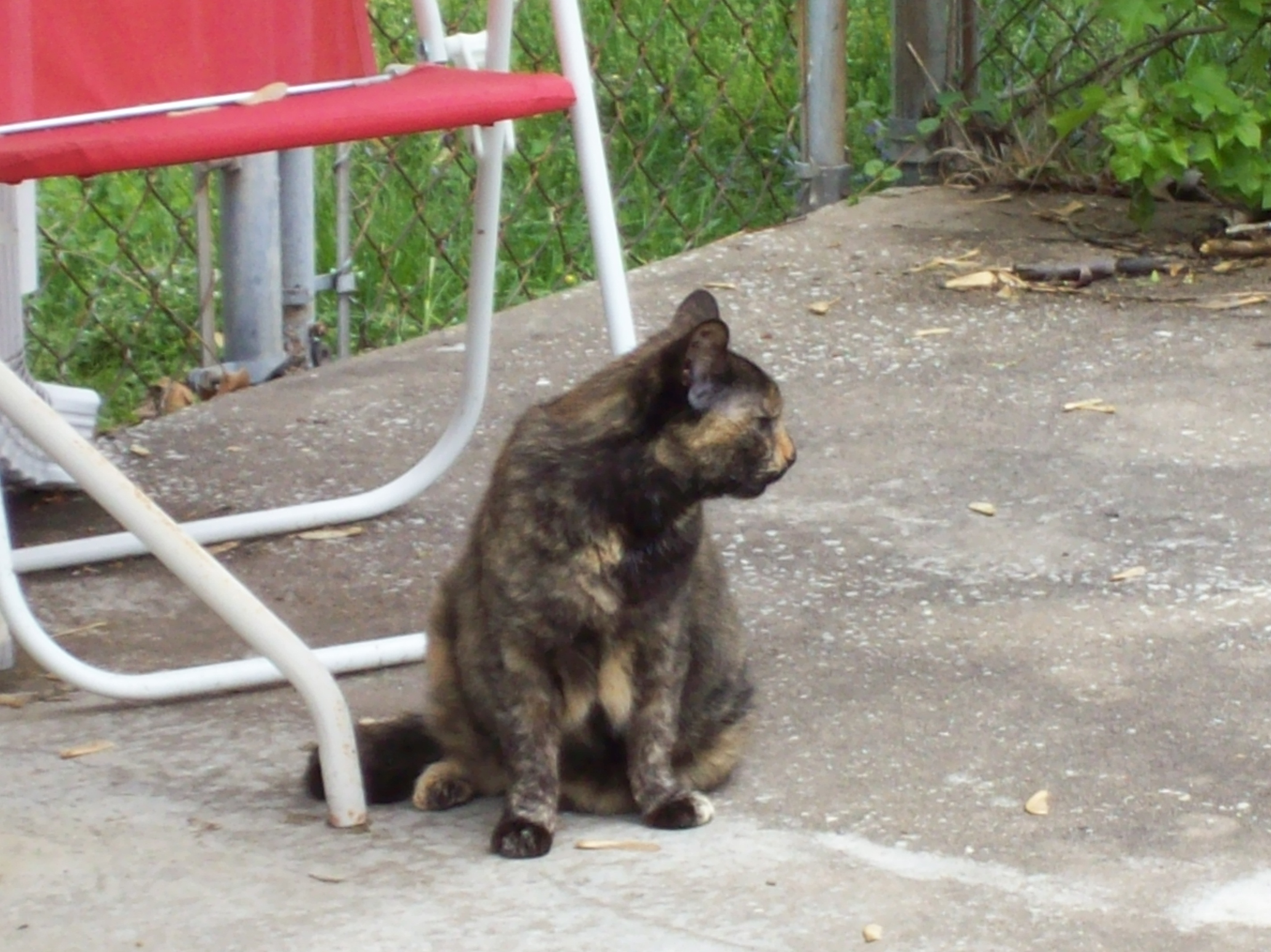
This past Saturday morning, I took Psycho Kitty to the vet to get her yearly shots.  She must be tricked into the carrier, which involves setting it outside near her food dish for a few days so she forgets about it.  Then comes the luring with treats, a kiss and pat, and poking her inside before she realizes what happened.

Is oblivious...or perhaps just doesn't give a crap.

I got to hear about it the entire way there, too.  Once in the exam room, she clammed up.  The doctor was very nice (why do I get a different one every time?) and the actual shots went smoothly.  As he was preparing the flea treatment, she did something so cute I nearly died.

This unsocialized, play-impaired, half-feral kitty scooted over on the table, tucked her head into my hip like a frightened two-year-old, and stayed there.  I patted her gently, spoke soothingly to her and WISHED LIKE HELL I’D BROUGHT MY DIGITAL CAMERA WITH VIDEO FUNCTION.

  • Reason Number One:  Moments.  When cuteness / astonishing feats / a horrible accident strikes, it pays to be prepared.

After returning Psycho Kitty to the house where she promptly disappeared under a bush, I drove to Branson, MO to find the small airport recently constructed there, from which I will soon be flying to see Certain Someone.  The town is located in the picturesque hills near where I live.  It’s easy to find, but the airport was another story.

The views were spectacular.  I don’t know if you’ve ever been to the Ozarks, but they are very pretty.  Not on the scale of Yosemite’s craggy peaks, they are more like the gently verdant mountains of eastern Tennessee and Pennsylvania.

Kinda like this.

Image:  Ron Bird/FreeDigitalPhotos.net

I drove and drove and drove, past town and all the way to Hollister until I missed the turnoff—damn tiny signs!  Since the airport is privately owned, I guess they don’t have that much traffic, and figured they didn’t need anything bigger.  The road winds in serpentine curves in and out and back on itself, and seems to never end.

I finally found it in deep within an exclusive area of golfing communities, after following an annoyingly slow pickup truck for several miles. The road is blasted through the mountains in spots, and you drive through walls of glowing, otherworldly yellow rock, half expecting to see Kirk and a redshirt appear.  I promise, I’ll take my camera when I return.

  • Reason Number Two:  Scenery.  You never know when you will happen upon something naturally spectacular.

While I was there, I thought I might as well go to downtown Branson and hit the flea markets.  There were a ton of people there, as usual for a tourist destination in the summer.  Cars parked everywhere, oblivious pedestrians strolling across streets and into the many little shops in the historic buildings.

In Branson, you have a mix of tourist crap and historic stuff.  Everything is geared toward visitors.  The people are very nice.

I found a flea market I’d visited during the 2007 ice storm, and a couple of others.  I think one of them, in an old building that used to be a feed store in 1918 when it was built, might be haunted.

The entire building is decorated—floors, walls, etc—in conflicting designs.  Anyone who has seen flea market booths with painted floors knows what I mean.  Somehow it doesn’t make your eyes bleed.

At the back is a set of creaky stairs and at the top, a large room.  I went into the room and immediately stopped.  It felt funny.  I wasn’t sure why, so I ignored it and looked around.  In the back left corner, I saw an item that interested me.  Standing in the corner gave me a very strange feeling, not sinister, but sort of a breathless, choky feeling, as though I needed to move.  I could not concentrate on the item.

I left the room and went to another upstairs, but it was uninteresting.  To test my experience, I went back and stood in the corner again.  Same feeling, same need to move.  Okay, time to go.

  • Reason Number Three:  Paranormal.  What might my camera have captured had I taken a picture in there?

The proprietor said I wasn’t the first person to describe that sensation in that room.  Ha! Vindication is mine.  I knew something was wonky up there.  He didn’t know why it was so, but he said “I believe in such things.”  I do too.

Writers should keep a camera handy.  Pictures can jumpstart your imaginative process.  If you have a personal anecdote that goes with the picture, that’s even better.  Digital cameras are cheap now; you can buy a decent one for under $100, with a video setting and autofocus.  They’re tiny and go in a purse, backpack or even your glove box.  No tricky film, no difficult settings; the instruction books help a lot.

If you have any suggestions for taking great pictures, please share in the comments.

Don’t Tell Me What to Do!

Unsolicited advice!  It’s everybody’s favorite!

“You know, dear, you should get married.  Find a nice man at church.   You’re not getting any younger, you know.” I know.  Shut the hell up.

“Move to Alaska!  It’s so quiet and there are lots of guys!” Yes, conveniently leave out the arctic cold, the giant hungry bears and the isolation.

“Know what you should do?  You should get one of those self-publishers. You can pay them to make you a book!” And it will sit neatly in boxes in my garage for the rest of my life.

“Have a baby!” Yeah, when the first one happens we’ll see.

“Sell your crap on Craigslist!” Actually, this one is pretty good.  I sold my kitchen table for $75.   Now I’m going through the house on a mission.  Everything is fair game!

Okay, so one out of five isn’t bad.  I’ve heard many versions of these over the years.  They always push my buttons, no matter who they’re from.

Why do we bristle so much when people give us advice?  Because unless we ask for feedback, we hear it as criticism.  If I ask for an honest opinion, it’s not very good form to get pissy with the person who gives it to me.   But if I’m just minding my own bidness, I can get all the pissy I want with you, because I did not ask for your feedback.

We’re an opinionated bunch lately.  I blame the Internet.  (Or, for SSTers, Nate.)  It’s given us a forum to express all kinds of ideas, random thoughts, ranty stuff, and advice.  The advice part is tricky.  When someone you care about is having difficulty, it’s tempting to offer the diamond-studded wisdom you know will lift her up.

What if she doesn’t want to hear it?  Then maybe you should keep it to yourself until she asks.

There are two kinds of advice that really bug me.

The givers try to help, but you’ve already tried everything they’re telling you.

They never believe you when you tell them that.  “Just do it this way.  No?  Then try my Aunty Margaret’s version.”  It never stops.  They’re sure if they keep making suggestions, one of them will be the magic bean.

How to Counter:

Sometimes just whining about something will make you feel better.  Your true friends will let you do this.  Unless you whine all the time, in which case they are justified in giving you a swat.

If you want to vent, tell them.  Say something like “I’m gonna blow, and I need you to just listen.”  Ladies, this works on men too, who like to offer solutions and don’t get why you don’t want to hear it.  There are times when solutions ain’t what you need.  You have to let them know that.

For those who won’t stop, simply smile and thank them.  You don’t have to listen or do what they say.

The givers have no idea what the bloody hell they are talking about.

This is the one writers have to contend with the most, as will anyone in a profession or activity where the inner workings aren’t known to most people.  As you learn the nuts and bolts, invariably roadblocks to progress will pop up.  The problem could be a lack of knowledge that you need to acquire, or a conundrum you need to take time to work through.  Well-meaning people will give you advice to try and ease your way.  Realize that unless they are actually experienced in the subject, they will not understand and their specific advice should not be taken.

How to Counter:

Understand:  I’m not dismissing advice givers who are coming from a similar place, like say someone who has juggled work/family and a new career/school/start-up business, who may know exactly what you are going through even though it’s not the same thing.  If those people want to help you cope, by all means let them.   Their advice will not only be helpful but valuable.  They should not be dismissed.

You can blow it off when other people tell you what you should write, or that you must pay someone to publish your book when you don’t want to, or any number of things non-writers will tell you about the business.  If you’re trying to learn from legitimate sources, you can’t afford to take bad advice that might wreck your career chances.  That’s like telling someone to run for President on the “Vote for me and I’ll dance naked on the White House lawn” ticket.

Instead, take the advice in the spirit in which it’s given—that of generosity.  Those who truly care for you will want the best for you and that alone is worth sitting through the most ridiculous suggestion on earth.

Squeeze that Story: Is It Fresh?

I read somewhere there are only eight facial types, which explains why you always see people who look like people you know.  Could the same be said for stories?  Is there really only a limited number of tales a writer can tell?

Originality is a problem for writers.  A short list of familiar stories might look like this:

  • Boy meets girl (or vice versa); boy loses girl; boy gets girl.
  • Good triumphs over evil.
  • Someone goes on a quest.
  • A young person comes of age and rights a great wrong (or several).
  • A hero fights either a monster or a powerful adversary.
  • A life-altering choice and its consequences.

Any and all of these can be combined into a story.  I see agent blogs and interviews where the literary agent says he or she is looking for something “fresh.”  How can the writer avoid the clichés inherent in not only fiction, but especially genre fiction?

Different genres have elements readers expect to see.  For example, romance must end on a positive note for the couple involved.  Readers of this genre expect a happy ending and a pox on the writer who doesn’t give it to them.  Thrillers need not end happily, but the villain is expected to be vanquished, at least temporarily.  The Joker may always be back, but Batman has to thwart him for a while.

Freshness results from combining these elements in a new way.  You can’t blindly follow the latest trend.  It will be over before you get there.  Some writers despair they will never invent something new.  Maybe not, but there’s a reason people read the same stuff over and over.  They like it.  Give them something to get excited about.

Change up the narrative voice.

How interesting would it be to read the same story from Joker’s point of view?  Or Alfred’s?  Writer Valerie Martin did this brilliantly in a rework of Robert Louis Stevenson’s Dr. Jekyll and Mr. Hyde.   Mary Reilly is Stevenson’s story told by Dr. Jekyll’s servant.  I know a plot element is good when I am insanely jealous that I didn’t think of it first.

Take a little-known element and bring it to the forefront.

Medieval stories often follow royalty and warrior characters, life in a castle, etc.  Karen Cushman wrote two excellent books for young readers set in the Middle Ages, Catherine, Called Birdy and The Midwife’s Apprentice, which won a Newbery award.

Birdy is the daughter of a knight.  Her family isn’t rich, although they are better off than Birdy’s best friend Perkin the goat boy.  Alyce’s orgins in Apprentice are a bit more crude; when we first meet her she is in a dung heap.

Cushman’s research vanishes into her depictions of life in the Middle Ages, from the rushes on the floor of the manor house to the villager’s festival activities and the midwife’s primitive obstetric practices.  Her details make the books more interesting.  If you search for seldom-used aspects of a period or way of life, you might even find a plotline lurking among them.  Piquing your reader’s curiosity will ensure they can’t put the book down.  In Arthur Golden’s Memoirs of a Geisha, not only were the story and the main character engaging, but the book detailed a profession traditionally shrouded in mystery.

Write fully-developed characters, and put them in situations that challenge them.

No person is one way all the time.  Your character could be the good guy, but he might be capable of some very dastardly deeds in his pursuit of justice.  Think Dexter.  Tons of shows and books have been done about forensic experts.  Dexter is a fresh twist.  He’s also a serial killer who kills other serial killers.  To lead a double life like this, a person would have to compartmentalize.  What happens when the walls break down?

Villains who want to kill and destroy without any provocation or reason pop up a lot in comics, genre fiction and movies.  Like a force of nature, they overwhelm and confuse the hero, who must figure out what is driving them.  If nothing is, then it just becomes a blocking exercise.  Kill the villain so he can’t blow up the dam.

Everyone has motives.  People do things because they want something in return.  What does your villain want?  What’s he trying to prove, or aquire?  Why?  If it’s power, what does he plan to do with it?  If the reason is somewhat clichéd, like revenge, at least show his way of thinking.  A real person trying to get revenge thinks he is justified in doing so.  Show why your villain feels this way.  It’s not just because he’s bad.

Besides an astonishingly great performance by the late Heath Ledger, one reason the Joker in The Dark Knight was so good is that he had a subtext.   He was evil but how anyone could miss the wall of pain pushing off the screen astonishes me.  I actually walked out of the theater feeling sorry for the guy.  There wasn’t even any concrete explanation for his scars.  His stories implied he either told part of the truth or the real reason was so awful even he couldn’t stand to repeat it.  How intriguing is that?

Turn a cliché on its head.

Bram Stoker took the walking corpse of Eastern European vampire legend and made him into a nobleman, Count Dracula.  He’s still a a monster, but now one that might go undetected.  Anne Rice did him one better by starting the vampire-as-romantic-figure trend with Interview with the Vampire.  Now vampires are lovers, not bloodsuckers.

For an even newer angle, check out the adolescent vampire in Let the Right One In.  Being heme-dependent is secondary to the plot; the story is really about the friendship between two misfit children.  In genre fiction especially, the best stuff is about people, not stereotypes.

Imbue your fiction with freshness.  Read celebrated new books in your category and try to see why they are so different.  Then make sure your writing is the best it can be.  If you have any recommendations for stories that set genre clichés on edge, please share them in the comments.

What’s That Ringing Sound? Ranty Phone Etiquette 101

Today I’d like to share another post about business etiquette.  As a working girl on the low end of the totem pole in most of my jobs, I have seen a lot of crap from the lofty pedestals above administrative support that makes my jaw drop.  The primary offenses have to do with phone calls.

Customer calls are high priority, no matter what you do.  Whether you’re a sales rep, a technical person or a freelance writer, these are the people who pay your bills.  They deserve your attention and courtesy.  In a previous post, I briefly addressed the matter of rude and entitled customers and I reiterate that you don’t have to take outrageous behavior from them.  You should, however, not give them any reason to legitimately complain.  It’s bad for business.

Common telephone offenses include:

  • Ignoring calls. You may be in a meeting or on another line.  You might be bogged down in a sea of paperwork and have to turn off the ringer.  You can change your message to briefly announce something like “I will be unable to answer calls for X period of time; please leave a message and I will return your call as soon as I’m available.” Then actually call people back.  That leads me to the next boo-boo.
  • Not returning calls. Dear heart, you could miss a job opportunity.  You cannot, in this economy, afford to blow off your messages.  If someone is calling about status, please talk to him anyway even if you have nothing to report.  I know some people are annoyingly persistent.  In these cases it’s okay to tell them “I will be working on your project and give you an update on Friday.”  No one likes sitting in limbo with no information.
  • Not treating everyone the same. This is a slippery one, but I’ve seen callers get poor treatment because they have an accent, at the very least jokes after they hang up.  That’s disrespectful.  The business world is global now.  I’ve heard people make remarks that they can’t understand someone’s accent.  Some are difficult if you’re not used to it.  It’s perfectly polite to ask someone to slow down or repeat something.  If you’re uncomfortable saying “I’m sorry, I’m not used to your accent,” you can blame it on the connection.   Don’t make fun, or assume that they are less intelligent than you are because they don’t talk the way you do.  Your contempt will bleed into your dealings with them.
  • Making the secretary or operator deal with your crap. Don’t make the phone lady explain to your caller why you don’t want to talk to him.  She probably has other lines ringing and has no idea what’s going on anyway.  And don’t make her fib to callers.  Tell your own lies.

On the other side of the pony, there are customer mistakes.  You might be guilty of some yourself.  So might I.

  • Bugging your account rep / agent / writer with incessant calls. I hate when people do this.  No wonder your party ignores you!  That’s no excuse, but still, it’s tempting.  If someone isn’t there, calling back fifteen times in an hour is not going to make her magically appear at her desk.  Leave a voice mail.  She can’t call back if you don’t leave a message, because she will have no idea you called.  Please take the issue up with her during your next conversation.

People who habitually don’t return calls might not deserve your business anyway.  Vote with your wallet.

  • Yelling. Do not, repeat, do NOT yell at the operator.  It’s not his fault you can’t get hold of your person or you have a problem.  Besides, he really doesn’t care; his only job is to transfer your call.  Being pissy or dismissive with him will not help you.   He can just put you on hold and tell the person you’re trying to reach that you’re being a dillhole, and that person can then decide not to take your call.  Too bad, Fred, Bob’s not in today!

Don’t tell him your life story either.  He has other calls waiting and probably six people breathing down his neck.

  • If you have a complaint, be polite, persistent and practical.

Polite:  Don’t yell or curse.

Persistent:  Continue to ask nicely for someone who can help you.

Practical:  Let that person know what the problem is and how it can be resolved.

  • Leave a clear, short message in voicemail. Don’t mumble.  State your name, your company, your phone number and then the reason you’re calling.  Give a time when you can be reached if necessary.  Repeat the number at the end.  Save the long, convoluted sob story for when you reach your party.  It probably won’t fit in the mailbox anyway and then you’ll get cut off and have to call back.

It’s not hard to practice good phone.  If you have any stories of egregious phone behavior, please share them in the comments.

Dealing with Disappointment: Writerly and Otherwise

It’s one of the hardest emotions to handle, and writers have to deal with it constantly.  It’s disappointment.

When you get a rejection, you deal with it.  When you call someone for information and they don’t come through for you, there it is again.  When things in your personal life are not going well on top of that, it can get overwhelming.

How do you cope?

  • Identify the cause of the disappointment. I don’t mean assign blame.  I mean think about why it’s there.  Did you expect something you didn’t get?  Were you supposed to do something and you forgot/blew it off, with consequences?  What happened to trigger that feeling?  Pinpoint it.

  • Recognize that it’s okay to feel this way. It’s okay to say “I’m disappointed that___” and fill in the blank.  Once you acknowledge the feeling, then the cause can be addressed. 

  • Control what you can control. That is, your thoughts.  Don’t let them veer toward negativity.  So things didn’t go the way you hoped.  Find the positive in a situation.  Concentrating on the negative will cause you to miss possible ways around the problem. 
  • Communicate clearly. Disappointment comes from our needs being unmet.  If you’ve left those needs unarticulated, how will anyone know what they are?  A significant other cannot read your mind.  If you need something, you must ask for it.   Remember, you can’t make that person do what you want.   You can only state your wishes.
  • If there’s nothing you can do, let it go. This is the hardest thing about disappointment.  The only way I know to cope with this is to push through the feeling.  If you bottle it up, it only gets worse.  A rejection is a perfect example.  Feel bad, feel sorry for yourself and then move on to the next query or revision.

Seek support when you are disappointed.  Keeping things inside tends to magnify them.  Bounce it off a friend and he or she may give you a fresh perspective on how to handle a letdown.  Write or journal how you feel.  In the course of putting your feelings down on paper, you might come up with a way to turn the situation to your advantage.

How do you cope with disappointment?  Please share in the comments.