Solitude

A comment I made on Jane Friedman’s blog There Are No Rules inspired this post.  Jane’s entry was about inspiration, and contained some quotes she found interesting about how writers can tap into their innermost selves when they are alone.

Tons of people think artists and writers are or should be solitary people, holed up in a studio or an office, painstakingly practicing their art at the point of a brush or the keyboard, with no distractions.  Actually, many writers struggle for those moments because they have so much going on in their personal lives.  Work, family, errands, chores; it’s all demanding.  Most of us don’t have the luxury of writing full-time, especially novelists.

What about the other side of the coin, those who don’t have much of anything?  I’ve known a lot of people who are alone, with no family or few friends.  They tend to bend your ear when you get a chance to talk to them, since at home there’s no one to listen.

I’ve been there.  Truly.  I’ve gone whole weekends without talking to a living soul, either on the phone or face-to-face.  Sometimes the only interaction I have is online.  Many times it’s by choice.  Lots of times, it’s not.  When I’m writing, that can be a blessing.  I’ve tried sneaking work during the day, and there are just too many damn interruptions unless I’m at lunch.

But other times, it sucks.  I’ve gone out and browsed around the flea market not because I want someone’s used dishes, but so I can be around other human beings.  (PS–It’s a great place for writers to eavesdrop on conversations.  Heh heh.)  Right now, I’m living in a place where it’s extremely hard to find like-minded people unless you belong to certain demographics, which I do not.  Judging by a local newspaper article I read a couple of years ago, I’m not the only one here with this perspective.

Writing is a solitary venture.  Even in a house filled with family, when we visit those worlds inside our heads, there’s no one there but us.  Eventually we have to pull ourselves out, if only to seek sustenance or use the bathroom.  That doesn’t mean your life has to be that way.

As I said in my comment, I think solitude is necessary for creativity, but too much isn’t a good thing.  The need for companionship, if not fulfilled, can usurp the good things about solitude and shut you down.  When you need food water won’t do it.  When you need to hear another human voice, forums and even chat rooms are dry bread compared to a steak sandwich. (Why do I try to write blog posts when I’m starving?)

Good writers need that human interaction.  You’re representing life.  Unless your book is set on another planet and your protagonists are all sentient squids, chances are you’re writing about other people.  Go out among them, if only to do field research.  If you’re lucky enough to have a family or live in a situation with housemates, you can mine them for inspiration, bits of dialogue and critiques.  And they will keep you anchored in the world.

For those who are mostly alone, I highly recommend seeking the company of other people on a regular basis.  It will help you recharge.  Church is good if you’re into that, or a group that involves some interest other than writing.  And no, online forums don’t count.  People need to be in the same room with each other.   Have some kind of activity other than your work to engage you.

Maybe you’ll find that your work is better when you isolate yourself.  That may be, but most humans are not meant to be completely solitary creatures.  Find your moments and use them and then get out there.  The reward is richer than you ever imagined.
Possibilities

Short post today; Christmas prep is underway.  I’ve finished all my shopping.  I received a present of my own to share with you.  Recently I opened my Gmail and found a notice for my very first pay as a writer, for test articles on a site to which I’m hoping to become a regular contributor.  Yay!

No, wait.  That doesn’t really do the moment justice.

OMFGYAAAAAAAAAY!!!!

That’s better.

I haven’t done this kind of informational writing before, using keywords.  It’s new to me.  I see it as a challenge, not an obstacle.  The more I branch out with different types of writing, the more avenues of success open up to me.

The thought exploded in my mind that a small beginning is ONLY the beginning.  For the first time in my life, I’ve tried something new, and it actually worked.  I know now I can do this.  I really can.  That’s the sort of realization that opens the world to a person.  If this can work, maybe my other writing will.  And someday, I may be gracing the shelves of your nearest bookstore.*

Most people work from necessity.  Few of us have trust funds.  It’s a great feeling to get paid for something you want to do rather than something you have to do.  Any time you can experience that, savor it.   Even small jobs add up to your collective experience.  Writing for websites can give you clips.   Pop these things on your resume or CV and rejoice in your hard work.  You should be proud of yourself when you finish a job well done, especially if you feel you’ve really earned your pay.

If you’ve earned money doing something you enjoy, please share in the comments.  Tell us why you chose to do it and how it felt to realize the possibilities of your dream.

*Oh please oh please oh please.

Is Writing Commercial Fiction a Sell-Out?

Nicola Morgan at Help! I Need a Publisher! inspired this post.  She had an older post about selling out and how it’s more difficult to get published now, because it’s all about sales and not so much writing anymore.

I went back and reread it recently.  Although Nicola is in the UK, her remarks are relevant in the US as well.

Nicola says in the comments, “Definition of commercial – simple: sells a lot. It doesn’t mean bad: it means popular. End of.”  She’s right.  Publishing is a business and these are business decisions.  A lot of writers think of what they do as art.  Many don’t consider commercial fiction art the way we think of it.  Art is Da Vinci, Shakespeare, and the like.

Here’s a wake-up call:  Shakespeare’s plays were commercial fiction.  In Elizabethan times, there were no movies.  People went to the theater.  The nobles got to sit in boxes, but the riff-raff had to stand downstairs.  Still, they went.  Everybody did.

Shakespeare cribbed story elements from other sources, the same way modern filmmakers do.  He mixed them up and presented them to a new audience in an entertaining way.  He invented new words and found common human elements in his stories that resonate with people even today.  That is why his works are classic.  They only seem literary to us because we don’t speak Elizabethan English.

What Shakespeare came up with sold in his time.  Dan Brown, Michael Palmer, Dean Koontz, Stephen King, countless romance authors, etc. are doing well because people buy their books.  This is what we like, people.  Art is subjective.

Writing my first novel (technically my third, but the first I’m actually trying to sell) and having to cut it back so much is teaching me a lot about commercial writing.  So is reading my favorite genre authors.  The next one I’m not even going to bother to flesh out as much.

Why?

  • It doesn’t need it.  I’m learning about making each word count, rather than trying to cover everything.  Show, don’t tell takes more time, but if I’m careful about details, I can show a lot in less space.  A shorter book is easier to sell.  At least that’s what I keep hearing.
  • It takes less time to write it.  If I have to keep working to survive even with books published and royalties coming in (don’t I wish!), I’ll have to make do with little bits of time the way I do now.  The luxury of full-time writing will never be mine unless I join the tiny ranks of million-dollar bestsellers.  Not bloody likely.

It’s not a sellout to choose popular fiction over literary fiction.  I don’t mind cranking them out as long as whatever I produce is entertaining and I’m happy with it.  I never saw popular fiction as a sell-out and I never will. That’s what I like to read, and that’s what I’ll write.  I don’t think I have a literary novel in me, and I like writing fight scenes too much.

In the comments on Nicola’s post, Bacchus replied, “I think it’s only selling out when you can no longer enjoy what your [sic]doing. Giving up your joy in a task is like giving up your very essence.”  She’s right too.   If that happens to you, the work becomes just work.  You’re marking time.

When you find yourself doing that, then it might be time to quit, or at least take a break until you find your joie de vivre again.  If I like the popular stuff and enjoy writing it, my chances are better because I’ll have an audience who already reads whatever it is, and my work will have spirit.

Apparently, then, getting published means find something that will sell, that you want to write, that is universally appealing and that you’re capable of doing justice to.  Not so hard!  We’ll see.

You can’t make it if you don’t try, that’s for sure.  Read posts like Nicola’s and take them for what they are, a gentle reminder to stay realistic in your pursuits.

Should fan fiction be legal?

If a writer posts her own UNPUBs online, there isn’t usually an issue.  But what if she creates a new story using someone else’s established characters?

Fan fiction delves into an area where creativity and copyright clash.  Star Trek, Star Wars, Buffy the Vampire Slayer, Harry Potter, Batman, it’s all out there.  People are writing new adventures for their favorite characters and posting them for other fans to share.  And they’ve been retelling tales with new twists for centuries.

I have nothing against fan fiction, although it’s not my chosen form of expression.  It wouldn’t surprise me if a lot of artists, in their imitative phase, produced derivative works and never showed them to anyone.  I did only one myself.  Yes, I shared it with a few select individuals.  No, it’s not online and you’ll never see it there.

Personally, it wouldn’t get my nose out of joint if people wrote stories about one of my published characters (if I had any, that is!), as long as they weren’t selling them.  I don’t really want people making money off my creations unless I license them to do so, as in merchandising, etc.  I may be open to that.

The issue gets sticky when fair use considerations rear their heads.  Chillingeffects.org, maintained by Stanford Center for Internet & Society, says “The fair use doctrine says that otherwise copyrighted works may be used for purposes such as criticism, comment, news reporting, teaching, scholarship, or research.

Fan fiction doesn’t fall under this description.  Why?

(Disclaimer:  I am not a lawyer.  For in-depth questions on copyright infringement, please consult a specialized attorney.)

When someone writes fanfic, as it’s commonly referred to, she creates what may be a derivative work using someone else’s established characters.  Under the original copyright, only the holder may have the exclusive right to use or reproduce them in new works.  If anyone else does it, that’s a violation.

Can you steal an idea?  Not really.  Ideas can’t be copyrighted.  They have to be developed in fixed media.  For those who wonder, that does include a computerized manuscript.  It’s not necessary to register your work unless you need to sue someone who stole it.  The very act of fixing it in a tangible form establishes copyright.

Look at all the works on bookstore shelves right now similar to Twilight. A vampire has a relationship with a human?  Buffy did it already.  Did Stephanie Meyer steal from Buffy? No, she took a trope (a common device) and created an original story around it.  So did all the writers who jumped on the Twilight bandwagon.

To make it clearer, let’s try an example.  Mary Sue and Bobby Joe are in a critique group tossing ideas around.  Mary Sue writes a story based on Bobby Joe’s musings about a vampire in love with a werewolf.  Bobby Joe can’t claim this plotline as his own creation because it’s generic.  He can’t stop her from writing her story or even publishing it.

If Bobby Joe publishes a book about the relationship between Fiona the vampire and Colin the werewolf and creates very specific characters, he then has a copyright on those characters.  Mary Sue can’t use them.  She can’t write about Fiona and Colin in a new adventure without violating Bobby Joe’s rights.  She can’t use elements unique to that work and those characters.

However, if Mary Sue were to write a parody of Bobby Joe’s book, similar to the Vampires Suck spoof of the Twilight film, that could constitute fair use and might be allowed.  A critical literary analysis of the Fiona and Colin saga as romantic horror fiction, even with quotes, could also fall under fair use.

What if Mary Sue’s adaptation isn’t published, either online or in print?  It’s still a violation.  I don’t know if Bobby Joe could sue based on this, or if he’d even want to.  If Mary Sue wrote the fanfic for her own pleasure or for no profit, even if someone else reads it, where is the harm?

Individual authors have their own positions about fanfic.  JK Rowling has said she is flattered by it, as long as it remains non-commercial and not obscene.  Conversely, Anne Rice states “I do not allow fan fiction. The characters are copyrighted. It upsets me terribly to even think about fan fiction with my characters. I advise my readers to write your own original stories with your own characters. It is absolutely essential that you respect my wishes.”

There are upsides to fanfic.  It’s certainly a means of tribute to a film, book or television series.  Fan fiction can help a writer practice craft elements like story structure, plotting, and editing without her taking the time to world-build.  Using established characters, she can practice stretching them while still staying true to their personalities.

My fanfic was a great way to get back into the novel form after a long period of mostly academic writing.  And I actually came up with a story I was able to adapt to my own characters.  As a writing exercise it’s useful, although I highly doubt I’ll ever go there again.

Fan fiction writers run other risks with their material.  DC Comics has this statement on their message board policy page:

By posting any fan fiction or proposed story ideas or plots on DC’s Message Boards, you waive any claims for credit or consideration of any kind as a result of DC’s publication or use of any similar matter in any manner or medium.

I am not a lawyer, but that reads as if they are saying “If you post something we like using our original creations, we can take your adaptation idea or even your script/written work and use it without recompense to you.” With this disclaimer, they could hire in-house writers to write your fanfic idea and you get nothing.

Fan fiction can be dangerous territory.  If you get busted for it, penalties are harsh and expensive.  And of course, your reputation could be damaged irreparably.  Perhaps someday authors and fans will reach an acceptable compromise with this issue.  Until then, it seems that fanfic writers will remain closeted and clouded in suspicion.

If you have any thoughts about writing fan fiction, from an author or reader standpoint, please share in the comments.  No personal attacks, please; let’s keep any debate polite and respectful.

Insight

Someone told me off recently.  Big time.  I think I mostly deserved it.  It brought to mind two things writers would do well to think about.

The first is image. We have a mental image of ourselves:  how we look, our behavior, how we sound, what other people notice about us.  Very often we’re wrong.  We tend to think of ourselves as better than we are, more generous, justified in our rage, and that our drama matters.

Truth?  No.  one.  cares.

You may be a consummate professional, always polite and well-coiffed and perfectly groomed all day long, always doing and saying the right thing.  I’m not you.  I’m a creative person and very loosey-goosey and will never be a tight, buttoned-up corporate type.  Neither can you do what I do, or be me.

That doesn’t mean I can’t think of you with respect and treat you accordingly, whether you are my brother, my sister, my boyfriend, my girlfriend, my boss or the person who bags my groceries.  It doesn’t mean that if you are disrespectful to me that I owe you a harsh word, either.

In the Internet age, everything you write and say in interviews and video of you and things people say about you are out there forever.  People who don’t know you will be buying your books, your art or seeing movies you wrote or acted in.  They will base their opinion of you on whether they like your work, but also on what other people are saying about you.

That leads me to the second, insight, and the title of this post. We know when we’ve done wrong.  We should, anyway.  I think today a lot of people have forgotten what shame feels like.  It’s a nasty feeling to think that you are not the kind of person you thought, or that others don’t like you.  It’s easy to take that and run have a pity party with it, but that’s not productive, nor is it correct.

A mistake is a learning opportunity.  How did it happen?  Why is someone angry with you?  Did you act without thinking?  What we do affects others, and we don’t always realize that right away, but the reaction we get can tell us much.

I accidentally cut someone off in traffic one day and waved a big “Sorry” at them.  They still honked and flipped me the bird.  Fine, if you feel that way.  I didn’t mean to.  But if ticking you off made me more aware of my lane changes, then I’ve learned something.

If someone tells me something about myself that I need to hear, it might make me feel like the ass end of a snapping turtle.  Can I grow from it?  HELL YES.  If I allow it.

Writers deal with rejection and criticism all the time.  I could easily take my rejections personally and never submit or query again.  Will I be a writer this way?  Yes, but never a paid one.  If I analyze my mistakes and see where I went wrong, my next query or article or book will be better.  If I’m rejected because of my attitude, then I only have myself to blame and I’ll never make it.  Same in life; who’s going to want to spend five minutes with me if I’m a complete bitch?

You can’t control what other people do.  You can control your temper—if you choose to—and you can control what you let yourself take from rejections, mistakes and your own choices.

If you have a poor image, writer or not, maybe it’s time to get to work on it.  You won’t have to worry about hiding anything if you clean up your mess and what’s more, if you own it.

My friend David said on Facebook, “I follow the 80/20 rule. If eighty percent of the time you’re a sweetheart, then who cares about the twenty percent when you’re less than perfect?  But if the eighty percent is cranky/bitter, then time to shop for new friends.”

My reply?  “If you are an eighty-percenter, time to get your head out yer ass!”  Or time to take my own advice.

Inspiration: “Where do you get your ideas?

If you’re a writer or artist who works strictly from your imagination, someone’s probably asked you the title question already, or they will.  When you’re rich and famous (ha!), some version of it will be standard.

The answers are as different as the writers asked.  Each person finds inspiration in varying places, at different times, in wide-ranging ways.  Nearly anything can spark an idea—an overheard conversation, a lovely (or ugly) view, something your kid just did that made you laugh.

What will you say when they ask you?  It might be one of these:

Nature

Beethoven often took insanely long walks around Vienna.  He loved being outside.  He would use the time to think and plan his music.   His walks inspired at least one symphony devoted to rural life, No. 6, the Pastoral. You may remember it from Disney’s Fantasia as the music from the centaur cartoon.

Take a walk outside.  What do you see?  Are there smells?  Of course there are.  What is that scent?  How about that sound?  Can you identify it without looking?  Exercise your body and your senses as well.  An element you perceive may not be a story element in itself.  It could be a catalyst for something percolating in your mind.

Eavesdropping

Chuck Palahniuk likes to write in public, to remind himself how people look, act and speak.  He’s doing field research.  You can too.

A coffee shop.  A mall.  The park on a nice day.  Go someplace where people tend to congregate.  You’ll see all kinds of interesting interactions, and overhear stuff you can use.  Remember, realistic dialogue does not mean reproducing a conversation exactly as you heard it.  People talk with lots of “um’s” and repetition that doesn’t play well with narrative.

Some people have trouble concentrating in such a setting, or are too self-conscious.  If that’s you, just spend some time there so you can gather observations.  Take notes.  You don’t have to talk to anybody.  Just listen and watch.

Music

You figured I’d mention this because of Beethoven, didn’t you?  Music invokes emotion.  What does your favorite music say to you?  How does it make you feel?  When you’re writing an emotional scene, try putting on some music specifically geared toward your character’s feelings.  Experience those emotions along with the character and see if that doesn’t punch up your scene a bit.

Or try changing the emotional timbre of the music in contrast to the scene.  A mashup may be just what it needs.  Instead of a happy wedding, try one where someone significant (bride, groom, minister) is seriously pissed off.

Try something new that you’ve never heard before.  Lately I’m listening to Arvo Pärt, the Estonian composer who wrote “Spiegel im Spiegel,” one of the most beautiful pieces of music in the world.  Classical music, whether modern or antiquated, accompanies the creative process very well.  Check Pärt out; he’s worth a listen.  Click the link on his name and you can hear some audio samples.

Personal experience

Although it’s a private document, Anne Frank: The Diary of a Young Girl is one of the most powerful stories to emerge from World War II.  Anne wanted to be a writer.  She plainly had talent.  She wanted to pen a book about the family’s experience hiding in Secret Annex after the war but sadly never saw her dream come to fruition.

Thanks to Miep Gies and Anne’s father Otto Frank, we have her diary.  It’s been in print since it was published, in more than sixty languages.  Her story of life in hiding under the oppressive Nazi occupation put a face on the war.

With the proliferation of memoirs in today’s market, this one is an easy answer.  Not everyone’s life is bestseller fodder, but nearly every writer has incidents in his/her past that can be mined for emotional resonance, dialogue, even folded whole into a narrative.

Be careful, however, that your experience enhances the work.  If it doesn’t, it shouldn’t be there.   You can get revenge on your snarky ex-boss some other way.  No need to make your action hero stuff a hand grenade down his thinly-disguised throat if he doesn’t need to.

History

War, particularly World War II, has inspired countless writers.  Children’s books like Lois Lowry’s Number the Stars and Judith Kerr’s When Hitler Stole Pink Rabbit, both fictionalized versions of real events, help educate people about the life and times of those who lived through the Holocaust.

Historical characters appear in other books as well, like Faye Kellerman’s The Quality of Mercy, a rousing murder mystery with William  Shakespeare as one of the protagonists.  There is no limit to unusual and interesting people one can draw from.

Browse the library or online for historical biographies or information about time periods. Wikipedia is a good place to start but not to finish.  It’s not a reliable source because it’s user-manipulated, but entries often have links at the end to better sites with peer-reviewed information.  Links in the articles might lead you to something obscure that would make a great backdrop for a story or a research paper, if you’re a student.

Television and movies

I’m not saying you should copy everything you see.  I already ranted about lousy movies here.  Please don’t subject us to that.  There’s enough out there as it is.

A good film or TV show makes you think.  It asks questions, puts well-rounded characters through their paces, sometimes in a way that makes you ponder the asides.  What if this happened instead?  If the story left a loose end, how would you resolve it?

Some awesome fanfiction has come from asking these questions, and no doubt some of it is adaptable to original characters and settings.   Even crappy stuff is useful.  Twist the concept; bend it to your will and come up with something better.

Try some of these if you’re stuck, or even if you’re not.  Got other places to get ideas?  Share in the comments.

Three Good Reasons to Always Carry a Camera

I need to start taking my camera with me wherever I go.  I missed a ton of photo ops recently, several in one day.

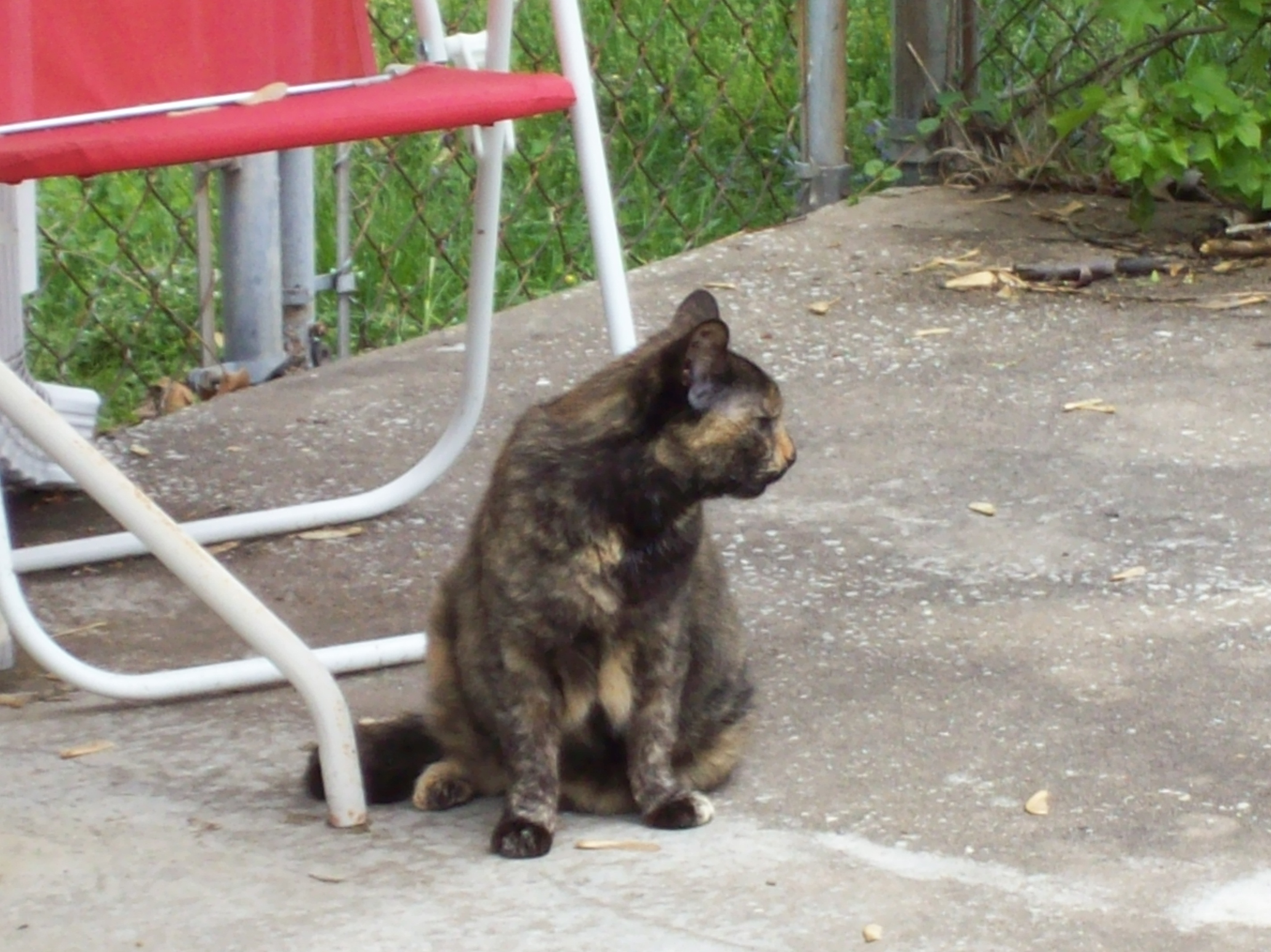
This past Saturday morning, I took Psycho Kitty to the vet to get her yearly shots.  She must be tricked into the carrier, which involves setting it outside near her food dish for a few days so she forgets about it.  Then comes the luring with treats, a kiss and pat, and poking her inside before she realizes what happened.

Is oblivious...or perhaps just doesn't give a crap.

I got to hear about it the entire way there, too.  Once in the exam room, she clammed up.  The doctor was very nice (why do I get a different one every time?) and the actual shots went smoothly.  As he was preparing the flea treatment, she did something so cute I nearly died.

This unsocialized, play-impaired, half-feral kitty scooted over on the table, tucked her head into my hip like a frightened two-year-old, and stayed there.  I patted her gently, spoke soothingly to her and WISHED LIKE HELL I’D BROUGHT MY DIGITAL CAMERA WITH VIDEO FUNCTION.

  • Reason Number One:  Moments.  When cuteness / astonishing feats / a horrible accident strikes, it pays to be prepared.

After returning Psycho Kitty to the house where she promptly disappeared under a bush, I drove to Branson, MO to find the small airport recently constructed there, from which I will soon be flying to see Certain Someone.  The town is located in the picturesque hills near where I live.  It’s easy to find, but the airport was another story.

The views were spectacular.  I don’t know if you’ve ever been to the Ozarks, but they are very pretty.  Not on the scale of Yosemite’s craggy peaks, they are more like the gently verdant mountains of eastern Tennessee and Pennsylvania.

Kinda like this.

Image:  Ron Bird/FreeDigitalPhotos.net

I drove and drove and drove, past town and all the way to Hollister until I missed the turnoff—damn tiny signs!  Since the airport is privately owned, I guess they don’t have that much traffic, and figured they didn’t need anything bigger.  The road winds in serpentine curves in and out and back on itself, and seems to never end.

I finally found it in deep within an exclusive area of golfing communities, after following an annoyingly slow pickup truck for several miles. The road is blasted through the mountains in spots, and you drive through walls of glowing, otherworldly yellow rock, half expecting to see Kirk and a redshirt appear.  I promise, I’ll take my camera when I return.

  • Reason Number Two:  Scenery.  You never know when you will happen upon something naturally spectacular.

While I was there, I thought I might as well go to downtown Branson and hit the flea markets.  There were a ton of people there, as usual for a tourist destination in the summer.  Cars parked everywhere, oblivious pedestrians strolling across streets and into the many little shops in the historic buildings.

In Branson, you have a mix of tourist crap and historic stuff.  Everything is geared toward visitors.  The people are very nice.

I found a flea market I’d visited during the 2007 ice storm, and a couple of others.  I think one of them, in an old building that used to be a feed store in 1918 when it was built, might be haunted.

The entire building is decorated—floors, walls, etc—in conflicting designs.  Anyone who has seen flea market booths with painted floors knows what I mean.  Somehow it doesn’t make your eyes bleed.

At the back is a set of creaky stairs and at the top, a large room.  I went into the room and immediately stopped.  It felt funny.  I wasn’t sure why, so I ignored it and looked around.  In the back left corner, I saw an item that interested me.  Standing in the corner gave me a very strange feeling, not sinister, but sort of a breathless, choky feeling, as though I needed to move.  I could not concentrate on the item.

I left the room and went to another upstairs, but it was uninteresting.  To test my experience, I went back and stood in the corner again.  Same feeling, same need to move.  Okay, time to go.

  • Reason Number Three:  Paranormal.  What might my camera have captured had I taken a picture in there?

The proprietor said I wasn’t the first person to describe that sensation in that room.  Ha! Vindication is mine.  I knew something was wonky up there.  He didn’t know why it was so, but he said “I believe in such things.”  I do too.

Writers should keep a camera handy.  Pictures can jumpstart your imaginative process.  If you have a personal anecdote that goes with the picture, that’s even better.  Digital cameras are cheap now; you can buy a decent one for under $100, with a video setting and autofocus.  They’re tiny and go in a purse, backpack or even your glove box.  No tricky film, no difficult settings; the instruction books help a lot.

If you have any suggestions for taking great pictures, please share in the comments.

Don’t Tell Me What to Do!

Unsolicited advice!  It’s everybody’s favorite!

“You know, dear, you should get married.  Find a nice man at church.   You’re not getting any younger, you know.” I know.  Shut the hell up.

“Move to Alaska!  It’s so quiet and there are lots of guys!” Yes, conveniently leave out the arctic cold, the giant hungry bears and the isolation.

“Know what you should do?  You should get one of those self-publishers. You can pay them to make you a book!” And it will sit neatly in boxes in my garage for the rest of my life.

“Have a baby!” Yeah, when the first one happens we’ll see.

“Sell your crap on Craigslist!” Actually, this one is pretty good.  I sold my kitchen table for $75.   Now I’m going through the house on a mission.  Everything is fair game!

Okay, so one out of five isn’t bad.  I’ve heard many versions of these over the years.  They always push my buttons, no matter who they’re from.

Why do we bristle so much when people give us advice?  Because unless we ask for feedback, we hear it as criticism.  If I ask for an honest opinion, it’s not very good form to get pissy with the person who gives it to me.   But if I’m just minding my own bidness, I can get all the pissy I want with you, because I did not ask for your feedback.

We’re an opinionated bunch lately.  I blame the Internet.  (Or, for SSTers, Nate.)  It’s given us a forum to express all kinds of ideas, random thoughts, ranty stuff, and advice.  The advice part is tricky.  When someone you care about is having difficulty, it’s tempting to offer the diamond-studded wisdom you know will lift her up.

What if she doesn’t want to hear it?  Then maybe you should keep it to yourself until she asks.

There are two kinds of advice that really bug me.

The givers try to help, but you’ve already tried everything they’re telling you.

They never believe you when you tell them that.  “Just do it this way.  No?  Then try my Aunty Margaret’s version.”  It never stops.  They’re sure if they keep making suggestions, one of them will be the magic bean.

How to Counter:

Sometimes just whining about something will make you feel better.  Your true friends will let you do this.  Unless you whine all the time, in which case they are justified in giving you a swat.

If you want to vent, tell them.  Say something like “I’m gonna blow, and I need you to just listen.”  Ladies, this works on men too, who like to offer solutions and don’t get why you don’t want to hear it.  There are times when solutions ain’t what you need.  You have to let them know that.

For those who won’t stop, simply smile and thank them.  You don’t have to listen or do what they say.

The givers have no idea what the bloody hell they are talking about.

This is the one writers have to contend with the most, as will anyone in a profession or activity where the inner workings aren’t known to most people.  As you learn the nuts and bolts, invariably roadblocks to progress will pop up.  The problem could be a lack of knowledge that you need to acquire, or a conundrum you need to take time to work through.  Well-meaning people will give you advice to try and ease your way.  Realize that unless they are actually experienced in the subject, they will not understand and their specific advice should not be taken.

How to Counter:

Understand:  I’m not dismissing advice givers who are coming from a similar place, like say someone who has juggled work/family and a new career/school/start-up business, who may know exactly what you are going through even though it’s not the same thing.  If those people want to help you cope, by all means let them.   Their advice will not only be helpful but valuable.  They should not be dismissed.

You can blow it off when other people tell you what you should write, or that you must pay someone to publish your book when you don’t want to, or any number of things non-writers will tell you about the business.  If you’re trying to learn from legitimate sources, you can’t afford to take bad advice that might wreck your career chances.  That’s like telling someone to run for President on the “Vote for me and I’ll dance naked on the White House lawn” ticket.

Instead, take the advice in the spirit in which it’s given—that of generosity.  Those who truly care for you will want the best for you and that alone is worth sitting through the most ridiculous suggestion on earth.

Dealing with Disappointment: Writerly and Otherwise

It’s one of the hardest emotions to handle, and writers have to deal with it constantly.  It’s disappointment.

When you get a rejection, you deal with it.  When you call someone for information and they don’t come through for you, there it is again.  When things in your personal life are not going well on top of that, it can get overwhelming.

How do you cope?

  • Identify the cause of the disappointment. I don’t mean assign blame.  I mean think about why it’s there.  Did you expect something you didn’t get?  Were you supposed to do something and you forgot/blew it off, with consequences?  What happened to trigger that feeling?  Pinpoint it.

  • Recognize that it’s okay to feel this way. It’s okay to say “I’m disappointed that___” and fill in the blank.  Once you acknowledge the feeling, then the cause can be addressed. 

  • Control what you can control. That is, your thoughts.  Don’t let them veer toward negativity.  So things didn’t go the way you hoped.  Find the positive in a situation.  Concentrating on the negative will cause you to miss possible ways around the problem. 
  • Communicate clearly. Disappointment comes from our needs being unmet.  If you’ve left those needs unarticulated, how will anyone know what they are?  A significant other cannot read your mind.  If you need something, you must ask for it.   Remember, you can’t make that person do what you want.   You can only state your wishes.
  • If there’s nothing you can do, let it go. This is the hardest thing about disappointment.  The only way I know to cope with this is to push through the feeling.  If you bottle it up, it only gets worse.  A rejection is a perfect example.  Feel bad, feel sorry for yourself and then move on to the next query or revision.

Seek support when you are disappointed.  Keeping things inside tends to magnify them.  Bounce it off a friend and he or she may give you a fresh perspective on how to handle a letdown.  Write or journal how you feel.  In the course of putting your feelings down on paper, you might come up with a way to turn the situation to your advantage.

How do you cope with disappointment?  Please share in the comments.

Shut Your Mouth! What Writers Should NOT Say

I was checking out a terrific agent blog I just discovered—Pub Rants, by Agent Kristen—and found an older post on what makes her cringe.  That is, bad-mouthing an agent or agency to whom you’ve submitted.

I can’t imagine how it would help a writer to do this.  Manuscripts do get rejected.  All the time.  Agents don’t always write you back.  It’s not because they’re evil or hate you or harbor a conspiracy against publishing your psychic-dog-meets-abused-child tome.

It’s because they’re busy.

Some agents receive upwards of 200 queries per day.  Can you imagine having to go through that many emails / query letters / packets before five o’clock?

This economy is in a funk.  Every industry is laying people off right and left, and that includes publishing.  If they’re anything like most places I’ve seen, they’re trying to make do with less personnel at a time when queries have increased tremendously.  In tough times, some people think they can just write a book and make some money.

WRONG.  Those people have no idea what kind of competition they face.  Competition whose manuscripts are polished to a high sheen, whose queries are brilliantly crafted and targeted.  Even a terrific book with a terrific presentation might still be passed on for reasons that have nothing to do with the writing.

Give ’em a break.  Don’t bust their chops.  Publishing is small and word gets around.  It’s like royalty; everybody knows everybody and there’s apparently a hot grapevine. Besides, who would want to work with someone who calls them a rude, illiterate bastard because they rejected a book for a reason that might make perfect sense to any other human being?

I know it’s tempting to rant on the Internet.  It’s also easy.  Anyone can start a blog for any reason or get on a forum and cut loose.  I’m really the pot calling the kettle black, because in the past, I’ve complained about things that bothered me without necessarily censoring myself, aloud and otherwise.

It’s okay to write about how bummed you are when you get rejected.  But keep the focus on you.  No one cares what you think of Agent X, except your comments might be passed on to that person.

Since I’ve been submitting both to agents and journals, all I’ve had is rejections (so far).  I really appreciate getting something back, even if it’s a form letter.  If I don’t get anything after their recommended response time (check the guidelines—it’s usually there), I mark that one off and MOVE THE HELL ON.

It’s still early in my career.  I have time.  I have things to learn, too.  And more books to write, so when that dream agent asks me “So what else are you working on?” I can say “This, and this, and oh wait until you see this.”

Do your homework, people.  Find out what makes a successful query, find out how publishing works, and for heaven’s sake, polish your writing.  Work hard on it.  You can’t blame anyone for the vagaries of fate.  But if your work isn’t its very best you have no one to blame but yourself.