What’s That Ringing Sound? Ranty Phone Etiquette 101

Today I’d like to share another post about business etiquette.  As a working girl on the low end of the totem pole in most of my jobs, I have seen a lot of crap from the lofty pedestals above administrative support that makes my jaw drop.  The primary offenses have to do with phone calls.

Customer calls are high priority, no matter what you do.  Whether you’re a sales rep, a technical person or a freelance writer, these are the people who pay your bills.  They deserve your attention and courtesy.  In a previous post, I briefly addressed the matter of rude and entitled customers and I reiterate that you don’t have to take outrageous behavior from them.  You should, however, not give them any reason to legitimately complain.  It’s bad for business.

Common telephone offenses include:

  • Ignoring calls. You may be in a meeting or on another line.  You might be bogged down in a sea of paperwork and have to turn off the ringer.  You can change your message to briefly announce something like “I will be unable to answer calls for X period of time; please leave a message and I will return your call as soon as I’m available.” Then actually call people back.  That leads me to the next boo-boo.
  • Not returning calls. Dear heart, you could miss a job opportunity.  You cannot, in this economy, afford to blow off your messages.  If someone is calling about status, please talk to him anyway even if you have nothing to report.  I know some people are annoyingly persistent.  In these cases it’s okay to tell them “I will be working on your project and give you an update on Friday.”  No one likes sitting in limbo with no information.
  • Not treating everyone the same. This is a slippery one, but I’ve seen callers get poor treatment because they have an accent, at the very least jokes after they hang up.  That’s disrespectful.  The business world is global now.  I’ve heard people make remarks that they can’t understand someone’s accent.  Some are difficult if you’re not used to it.  It’s perfectly polite to ask someone to slow down or repeat something.  If you’re uncomfortable saying “I’m sorry, I’m not used to your accent,” you can blame it on the connection.   Don’t make fun, or assume that they are less intelligent than you are because they don’t talk the way you do.  Your contempt will bleed into your dealings with them.
  • Making the secretary or operator deal with your crap. Don’t make the phone lady explain to your caller why you don’t want to talk to him.  She probably has other lines ringing and has no idea what’s going on anyway.  And don’t make her fib to callers.  Tell your own lies.

On the other side of the pony, there are customer mistakes.  You might be guilty of some yourself.  So might I.

  • Bugging your account rep / agent / writer with incessant calls. I hate when people do this.  No wonder your party ignores you!  That’s no excuse, but still, it’s tempting.  If someone isn’t there, calling back fifteen times in an hour is not going to make her magically appear at her desk.  Leave a voice mail.  She can’t call back if you don’t leave a message, because she will have no idea you called.  Please take the issue up with her during your next conversation.

People who habitually don’t return calls might not deserve your business anyway.  Vote with your wallet.

  • Yelling. Do not, repeat, do NOT yell at the operator.  It’s not his fault you can’t get hold of your person or you have a problem.  Besides, he really doesn’t care; his only job is to transfer your call.  Being pissy or dismissive with him will not help you.   He can just put you on hold and tell the person you’re trying to reach that you’re being a dillhole, and that person can then decide not to take your call.  Too bad, Fred, Bob’s not in today!

Don’t tell him your life story either.  He has other calls waiting and probably six people breathing down his neck.

  • If you have a complaint, be polite, persistent and practical.

Polite:  Don’t yell or curse.

Persistent:  Continue to ask nicely for someone who can help you.

Practical:  Let that person know what the problem is and how it can be resolved.

  • Leave a clear, short message in voicemail. Don’t mumble.  State your name, your company, your phone number and then the reason you’re calling.  Give a time when you can be reached if necessary.  Repeat the number at the end.  Save the long, convoluted sob story for when you reach your party.  It probably won’t fit in the mailbox anyway and then you’ll get cut off and have to call back.

It’s not hard to practice good phone.  If you have any stories of egregious phone behavior, please share them in the comments.

Memories of Independence Day

Happy Fourth of July to all American friends!

When I was a kid, this was my favorite holiday, next to Halloween.  Because we lived outside of town, we could shoot off as many fireworks as we liked.  For days before the holiday, my siblings and I scraped bits of our allowances together and visited fireworks stands, thoughtfully shopping so as to make our meager money stretch as far as we could.

A large variety of crackers ensured we’d be active throughout the day.  In the morning there were snakes.  We carefully lit the black tablet and watched black, ashy coils unfurl in a welter of poisonous-looking greenish smoke.  We also bought snakes that glowed a fiery red for use after dark.

You could use a punk to light the fireworks, which the vendors gave free with a purchase, or matches.  I preferred the matches.  Punks often went out.  They looked like incense sticks only with no scent.  I would use them until I got disgusted with them and then switch to matches.

Snappers, tiny sacks of powder that exploded when flung hard onto the concrete patio, left a mess of tissue and not much excitement.  Better were champagne poppers.  You held the plastic bottle with the end pointed away from you or anyone else and pulled the string, releasing a loud bang and a cascade of tiny colored streamers.  I liked these because I could take the streamers and decorate my Barbie house with them.  We made so many things for our dolls it was only natural.

Smoke bombs were a great favorite.  They hissed and spit, their colors wafting over the lawn.   It was fun to put two or three different ones together and watch the colors combine in the breeze.  Sometimes one would fizzle and sit inert on the gravel driveway; after careful observation, it was concluded that it was a dud.  We consigned the poor bomb to the depths of a metal washtub full of water.  All dud crackers, the spent remains of sparklers and burnt-out matches and punks went into this washtub, no exceptions.

I don’t remember our parents being out there much with us but the rules were absolute.  Always have the tub of water handy.  Never EVER hold a cracker in your hand; light it on the ground and get away.  Don’t point anything at anyone, especially bottle rockets.  If we violated these rules, the fun was over until next year.

Nowadays, kids aren’t allowed to touch anything.  We probably courted death every year, but none of us ever got hurt save a burn or two from a hot sparkler, which we quickly learned not to touch.  The bottle rockets were usually shot from a soda bottle angled against a pile of gravel.  Occasionally we held the stick when Mom wasn’t looking, but I didn’t like that because it was too scary and sometimes left a pink splinter when it zoomed out of my hand.

Thunder Bombs or Black Cats made a deafening noise.  I always loved to light a string of them and let them all go off at once, so I got a packet just for that.  We liked better to light them one at a time.

We did demolition: little piles of gravel in a cone shape with a cracker in the top like a stick of dynamite.  Crouch over it, excitement fluttering in the chest, and touch the flaming match to the fuse.  It sparks, hissing and crackling.  Scramble up and away, always with the terrible fear that one might slip and fall and remain in dangerous proximity to the impending explosion or running, miss it.  When far enough away, the breath held while the little fuse burns itself out.  Finally, the crack and boom of the tiny blast, gravel scattering everywhere, up and out.  A dance of laughter and elation, and back to the driveway to start again.

As the day wore on, lunchtime came.  We retreated to the cool house to eat.  There was always a lull in the afternoon.  Sometimes we had guests who usually arrived close to evening.  In the summer it usually didn’t get dark until nine o’clock.  My parents’ friends would bring their kids and we would run around outside, stuffing ourselves with hot dogs, potato salad and other goodies.  Homemade ice cream followed.  Someone would have to turn the crank, and another sit on the top of the freezer because the ice cream container liked to migrate up as the crank turned.    A folded pad of newspaper served to shield shorts-clad bottoms from the ice packed around the container.

My mother often made a juice and ginger ale punch.  It tasted orangey and fizzy and delicious.  One time someone brought beer, and my dad let me taste a tiny sip.  It was terribly bitter and the grownups laughed at the face I made.  I’m still not a fan of beer, although I like a good dark ale now and then.

I would break out the parachutes, cardboard tubes with a plastic bottom that shot a wadded-up missile into the air.  It unfurled as it fell into a tiny pink or yellow parachute with a little ball of sawdust as a weight.  Though they made sparks, I shot them during the day so I could find the parachute after they were spent and play with it later, prolonging the holiday.

When evening fell, fireflies made their own fireworks around the yard. They flashed greenish-white in the deep shadows over the rose beds close to the house.  Out came the sparklers, long metal sticks coated with combustible solids.  They looked like long gray punks.  A match flame held to the tip and they burst into a shower of light.  The sparks hurt like hell if they fell on skin, so we were careful to keep them at arms’ length as we waved them around in the dusk.

Flowers spun on the ground with a buzzing hum and changed from pink to yellow to green.  They were so energetic!  We lit Catherine wheels.  We hung mysterious flat packets on the branch of a tree that whirled madly and dropped a paper lantern that could be kept (unless it caught on fire).  Cone fountains sparkled orange and white on the driveway.

Dark came and time for the Roman candles.  This was the only firework I held in my hand.  I would light the fuse and point it up into the sky, angled slightly.  I could feel the thumping burst in my palm as the ball moved up through the tube.  It arced up into the sky but I scarcely saw it, absorbed as I was in the sense of power pulsing in the flimsy tube.  If I had kids now, there’s no way I would let them do that.  Thinking about what might have happened if the candle blew up makes me shudder.  It never did, though.

The night wore on and finally it was time for the big guns, the large rockets.  Again the soda bottle came out, this time jammed into a shallow hole in the ground some distance from the house.  My father and I usually lit these.  The guests would sit on lawn chairs with their littlest kids drowsing on their laps, oohing and ahhing over the chrysanthemum bursts and chasers and waterfalls.  After the last one had gone, they cheerfully packed up their chairs and leftovers and drove away in a flurry of thanks and good nights.   Time for bed for us.

The next day we always had to pick up our trash, bottle rocket sticks, torn paper, stray parachutes and dud firecrackers.  We played Fourth of July for days afterwards with rocks and the stems of weeds standing in for actual fireworks.  For some reason it usually rained the day after the Fourth.  My mother told us the fireworks shook up the clouds.  We liked that.  We controlled the weather!

The significance of the holiday was lost on us.  We never really thought about the fact that we were celebrating our freedom from British rule, that without a posse of brave and ragtag soldiers we still would have been oppressed and controlled by another country.  Our history is far removed from most of us and we feel entitled to the freedoms that were paid for with blood and pain, frostbite and starvation.  A fitting legacy to this would not be fireworks, but a continued search for peace among all men, regardless of race or creed.  We don’t need any more wars.

Start in your community.  Promote tolerance and understanding.  Get to know your neighbor, your enemy.  Stand in his shoes and see what he sees.  You might be surprised to find you’re not so different after all.

How to Buy a Present for a Writer

I had a birthday a month ago and for once, I received some DVDs that I actually asked for rather than a random present.  I also got an awesome surprise gift that had personal meaning and is in use right this very minute.   All in all, it was a terrific birthday.  :)

A thoughtful gift takes into account the recipient’s tastes, desires and personality.  It doesn’t have to be a surprise.

As both a writer and a skater, I’ve noticed that gifts for people who define themselves by profession or hobbies tend to be somewhat unimaginative.  A necklace with a skate charm or a t-shirt with one of Shakespeare’s quotes makes a nice gift.  It’s appreciated.  But sometimes, I wish people would pay more attention to what we NEED.

If you don’t know, ask.  We are not shy about telling you what we lack.

You don’t have to buy something writing-related for your writer.  But if you want to, we can always use:

  • Paper / office supplies. Get your writer a gift card to Staples.  I can run around in there for days.  If someone gave me a fully loaded Staples card, I’d marry them.
  • A good laser printer. This makes a great gift, if you can afford it.  I splurged on a commercial grade one, but HP makes some decent home ones too.  You can’t print a 400-page manuscript on an inkjet printer.  You’ll kill it.
  • A subscription to an online file storage site like Dropbox, Carbonite, or Mozy. IF YOU’RE NOT BACKING UP YOUR WORK, DO IT NOW!  You can do it to an external drive or upload it into the cloud.  These sites offer backup services that can do your whole system regularly for a nominal fee.  It’s a small price to pay for peace of mind, in the event of a system failure or a clumsily-handled cup of coffee.
  • Books. About writing, editing, or a gift card so we can pick out what we want.  Most writers like to read also, so if you know who your writer’s favorite author is, pick up their latest.  The newest edition of the Writer’s Market guide is a terrific present.
  • Webinars and workshops.  Professional development is important.  Writers don’t often have a lot of money for workshops.  Find out which ones they would like to attend and get them a ticket.  Not all are expensive; Writer’s Digest has some online webinars for under $100.
  • Computer accessories. Power supply, a laptop case, or a mobile broadband card.
  • Time. Do some chores when your writer is working.  Most of us have not quit our day jobs and might not be able to for a long time, so help us out.  Take the kids to the park, do the dishes for us, field phone calls.  Let us work uninterrupted for a while each day.  It’s very hard to find time to write when you work and then must care for a family or household.  Even writers without kids have a hard time of it, especially if they live alone and have no one to help them do yard work, etc.   It’s a cheap gift, but one of the best.

Check with your writer and see what they would like to receive for a birthday or Christmas gift.  If you have any suggestions, please share them in the comments.

Grrrr!!!

Update – After a couple of weeks with the pool cover on (mostly), the birds have vacated the tree.  Seems they really only wanted a toilet after all.

tears up*

Naahhh… WOO FREAKING HOO!

We interrupt your regularly scheduled blogging to bring you a ranty message from Disgruntled Pool Owners of Missouri vs. The European Starling!

Normally, I like birds.  Flamingos, roseate spoonbills, eagles, doves, even pelicans have their charm.  Well, maybe not; if you’re sitting on the beach when a flock of pelicans flies over, you might want to have an umbrella.  But not starlings.

Spoonbill at the Tucson, AZ zoo. Lovely bird. Yes you are. (Photo by Elizabeth West)

In 1890, in New York City, someone who wanted to have all the birds mentioned in Shakespeare’s plays released a bunch of starlings, among other birds, in Central Park.  I hate him and want to desecrate his grave.

Remember the government stimulus checks everyone got a few years ago?  I called them Dubya checks.  With mine, I purchased several DVD sets of Looney Tunes and a 12×3-foot backyard pool.  I don’t regret the DVDs in the least, but the pool is starting to get on my nerves.

First of all, whatever genius built this Fifties tract neighborhood made the backyards (mine, anyway) from fill, with a thin layer of topsoil over it.  And the entire yard slants toward the house.  The soil is disgustingly fertile and so far, everything I’ve planted grows like a maniac.  The weeds do too, unfortunately.

Where to put the pool?  I couldn’t put it on my patio, because it would be in the sun the entire day.  I’d tried that already with a smaller, inflatable pool and it just wasn’t an ideal location.  I don’t like hot pool water, or sunburns.

My neighbor to the west has a beautiful, tall linden tree in her yard, whose shadow cools the far south end of my yard during the afternoon.  A perfect spot.  A few leaves were no big deal.  I attempted to dig out a large flat circle and level the yard a bit, to put the pool down.  No dice.  With all the rocks, I just couldn’t do that effectively.  So the pool leans a bit.  No biggie.  I can deal.  The water stays level, after all.

I have no outside outlet, so I have to run the pump off an extension cord.  Also no biggie.  I would just do that once a week and clean it with the net the rest of the time.  Linden trees drop a ton of teeny tiny seed things in addition to leaves, but they aren’t difficult to scoop out before I settle into my floaty paradise.  Even bugs aren’t a problem.  They mostly stay on top and come right out with the leaves.

For two summers, I enjoyed floating in the shady coolness in my inflatable chair, a can of Arizona Green Tea stuck in the drink holder, or attempting to swim a little (the water only comes up to my thighs).  I anticipated just such a relaxing time this year, and as soon as the weather warmed, up went the pool.

And then, they came.  The starlings.

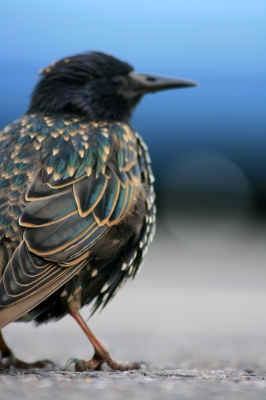
They like water.  I knew this, but I didn’t know why.  Now I do.  They use my sparkling watery paradise as a toilet.  They perch on the edge and blast their white, black and purple bombs right into my lovely, lovely pool.

Evil poop machine from the bowels of Hell.

Image: Simon Howden / FreeDigitalPhotos.net

I’ve swum in lakes, oceans, creeks and ponds.  You expect a bit of poo in there.  After all, living creatures use these bodies of water as their homes.  But pools should not have poo in them.   They should be pristine.  They aren’t natural.  They’re artificial constructs of chlorinated perfection, and bird poo is not welcome.

And if you have guests, it’s embarrassing.

These birds roost in the mulberry tree next to the pool.  Unfortunately, it’s not in my yard, and I can’t cut it down.  So I did the next best thing; I bought a cover.  That’ll help, right?

Wrong!

Missouri. Is. WINDY.   It starts in October and doesn’t let up until July, when the weather turns to hot, humid hell.  Gasping, sweaty people flock to the city pools and their backyard oases, praying for a breeze that never comes.  And the wind flutters the tree limbs, blows the linden flotsam across the grass and flips the pool cover right off.  So everything on it, linden seeds, leaves, bugs, bird poo, runs right off and into the water.

I give up.  Seriously.  There is no way I can work all day and come home and deal with this disgusting mess.  Stop using my pool as a toilet, birds.  I’m going to Walmart and buying a BB gun.  Gonna shoot into the tree and scare the little bastards away.  Gonna buy some shiny Fourth of July streamers and hang them in the tree and freak their little bird minds.   I don’t feel one bit sorry for them.  I’d hire a bird removal company, but I can only pay them in cookies right now.

If you have any suggestions or a bird story of your own, please feel free to share in the comments.  PLEASE.  I’m taking applications for bird hitmen.  I’m paying in chocolate chip and molasses drops this week.

Remake Rants

I have a couple of questions for Hollywood.

What happened to original material?  And how about you read a good book once in a while?  Then you’ll know what makes a story.

What’s with all the remakes?  I mean, come on.  Movies that don’t need to be remade, rebooted, and reimagined are coming out in droves.  Television shows, some really terrible, get the full treatment.  Even Avatar, which should have been a triumph, was pretty but had a story so full of tropes it was totally predictable.  Boo!

I get it; it’s about money, guaranteed sales, etc.  Stop playing it safe, Hollywood.  Chris Nolan took a chance on rebooting Batman, and it was worth it.  A very original take on familiar material.  Batman is a pretty good draw, although no amount of money will make me watch Batman Forever or Batman and Robin.  I don’t care if George Clooney comes to my house naked and begs me to watch with him.

The worst part of this trend is younger people who don’t remember the originals are stuck with the lousy remakes.  And just try to get some of them to watch.  Next time some kid says “Old movies are boring” I’m gonna slap him silly.  Now get off my lawn!

As a rule I tend to boycott remakes, especially of classic films that don’t suffer from having been made before CGI, or 3D or any other acronym of special effects wonderment.

Here’s a list of a few films that should probably have been left alone:

  • The Day the Earth Stood Still (1951). Really?  DTESS is a classic of science fiction starring Michael Rennie and Patricia Neal.  The political stuff alone makes it worth watching.  The world’s reaction to the saucer, and the shooting of Klaatu the moment he steps out of it don’t lose a thing with time.  Neither does Bernard Herrmann’s scary theramin music.  It’s hard to believe this film was made fifty-nine years ago.
  • The Omen (1976). Hands up if you saw this scary evil kid film when it came out or on TV.   If not, you missed something.  Gregory Peck, David Warner and the lovely and incomparable Lee Remick are outstanding in this tale of a diplomat’s son who is also the Anti-Christ.  It’s Gregory Peck, people!  David Warner will be familiar to anyone who saw Titanic; he played Rose’s boyfriend’s evil minion Lovejoy.  Two decent sequels followed.  The film’s composer, Jerry Goldsmith, won the Oscar for Best Original Score.   Who was in the remake?  Anybody remember?  Hmmm?  I didn’t THINK so!

  • The Haunting (1963). Directed by Robert Wise and starring Julie Harris, Claire Bloom and Russ Tamblyn of West Side Story (yes, he’s Amber Tamblyn’s father), this creepy movie was adapted from Shirley Jackson’s novel of the same name.   It’s the scariest haunted house movie ever.  In one scene, the characters wake late at night to a terrifying pounding noise out in the hall, moving down toward the door, which bulges inward in an impossible way.  You don’t see a thing here, but what you think might be on the other side will give you nightmares.  The only palatable thing about the remake was Catherine Zeta-Jones, who is always good even in crap.  I hope they paid her well.

  • Clash of the Titans (1981). Again with the CGI, this time also adding 3D.  The 1981 film starred Harry Hamlin, Burgess Meredith, Maggie Smith (Professor McGonagall!), Claire Bloom (again), and Laurence Olivier as Zeus.  Top that!   Famous stop-motion special effects guru Ray Harryhausen did the creatures.  The original was campy and fun; according to reports, the remake had nothing going for it.  They even showed the Kraken in the trailer; way to spoil the climax of the film before anyone even saw it!  I still might watch it on DVD, but I’m glad I didn’t pay theater prices to see it.  Sam Worthington starred, fresh off Avatar, where he was pretty good despite the weak material.

SSTers, please enjoy a hilarious spoof / review here by leviathan12.


  • Poltergeist (1982). This one is just a rumor, but please, please, don’t.  Just don’t.  Forget the curse; there isn’t one.  Just don’t do it.  You can’t make it scarier than the original and I know you, Hollywood.  You’ll just go too far and bore us to death.  Too much CGI doesn’t work any better than none.  Countless people who saw this one when it came out remember it as one of the scariest films they ever watched.

A couple of exceptions to the “remakes suck” rule are worth mentioning.

  • The Thing (1982). Duuuuude.  If you haven’t seen this, rent it immediately, but don’t watch it alone.  It’s one of the few horror movies that can actually creep me out.  I’m totally jaded, but this got me in a way I can’t even explain.  The original Howard Hawks film from 1951, The Thing from Another World, is based on a novella by John W. Campbell, Jr. called Who Goes There? You can read it online here.  It’s a pretty good film—James Arness of Gunsmoke plays the Thing—but this one is better.  Ennio Morricone, great Italian soundtrack master who scored such films as The Untouchables and The Good, The Bad and the Ugly, wrote some of the scariest music imaginable for this film.  It stars Wilford Brimley, Kurt Russell, Keith David, and Richard Dysart.

  • Little Shop of Horrors (1986). A campy musical adaptation of a 1960 Roger Corman vehicle, this is a delight.  It was originally done off-Broadway.  The songs are great, the story is fun and the actors enjoyed themselves hugely.  I’ve seen the original; it was Jack Nicholson’s first credited film appearance (he played the masochistic dental patient) and was hysterically funny.   Apparently, the musical had a much blacker ending than the film and they changed it, but this one is good too.  Rick Moranis, Ellen Green (who played Audrey in the stage version) and Steve Martin as the dentist star.

Both these films are a good example of doing something fresh with the original material.  We need more original screenplays or works adapted that are new to the screen.  Watchmen may have been flawed, but it was damned enjoyable.  They tried, by God.  They got good actors and really gave it a go.  Comic and other genre movies are getting a good trial right now.  If you treat the material seriously you’ve got a winner, not just from established fans but the new ones.  Look at The Dark Knight; Heath Ledger won an Oscar not because he died, but because he took an iconic character and made something out of it that was more than a cartoon.

Take The Lord of the RingsReturn of the King won Best Picture.  Let me reiterate:  a fantasy film won Best Picture.  Geeks everywhere creamed their jeans over that one.  Yes, it had loads of CGI and couldn’t have been done as well without it, but talk about using it responsibly.  Hell, yeah.  Thank you, Peter Jackson, for creating such a masterful adaptation and opening the door to a whole new world of filmmaking.  There are a ton of books out there that would make great movies, some fantasy, some not.

Grow a pair, Hollywood.   Audiences are more sophisticated than they were.  People are tired of CGI; it can’t carry a film if there’s no story, and the same is true for 3D.  Tim Burton’s Alice in Wonderland was good but didn’t need the 3D.  Avatar did because the story was so weak.  Audiences, do your part by not paying to see lousy remakes of good films, or crappy TV shows.  Let’s raise the standards of our entertainment by demanding quality content.

Got any good remakes you’d like to suggest?  Please share in the comments.

Duck and Cover

Since severe weather season is upon us in the Ozarks, I thought I would share my scary story with you.  First, a little background.  When I’m not writing, I work for a manufacturer in my city’s industrial park.  We’re out east of the city, in a big bare spot carved out for the park.  Last year, on May 8th, my workplace got hit with a tornado.

That morning, the TV weather warned that a derecho was on the way.  Meteorologists expected high winds, possible tornadic activity and heavy rains from this storm, sometimes known as an inland hurricane.

The sky was utterly black; the streetlights were still on.  As I drove, I felt a creepy unease.  For some reason I had worn my watch that day, which I usually don’t.  I glanced at it.  It was ten to eight; it could have been midnight.

At work things were as usual, but people got up occasionally and went to the windows to check out the sky.  It had lightened enough so the streetlights were off, but still scary dark.  I had the radar up on my computer, as did several others.  Around 8:30, the National Weather Service put out a tornado warning for my city.  We stopped working altogether and gathered near the bathrooms, our safe place.  A vendor came in for his weekly visit and we invited him to shelter with us.

Suddenly the wind rose sharply, and the building began to shake.  Our safety manager yelled “GO! and we all broke and ran for the bathrooms.

Inside, we could hear the building creak and the wind howl.  The lights went off and the emergency lamps came on.  I was so scared I grabbed a coworker’s hand and held on tight, until gradually the winds began to subside and silence crept over us.  We could hear something creaking and flapping and I said, “Something’s loose.”

We came out and immediately went to the windows, which fortunately were still intact.  Our plant across the street had been hit.  An enormous section of the roof lay gnarled up on the ground east of the building like a giant, crumpled gum wrapper.

Weirdly, a plant worker’s pickup truck, which had been parked on the west end of the parking lot near the access road in front of the stricken building, was now out on the access road, pointed back at Plant 1, where the office was.  Although the Weather Service never confirmed it, that’s when I knew for sure it was a tornado; it had blown the roof off one way, and moved the truck the other.

Little chopped green bits of leaves had been plastered all over the windows and when I went out later, I found them all over the door.   A semi trailer that had been parked at Plant 2’s dock was blown over.  We were all afraid it had crushed our shipping manager’s car, but he’d parked on the other side and it was okay.   He later said he hated that car and he wished it had!

The wind picked up again, and the radio blared high wind warnings until 1 p.m.  No one could go outside for a while.  When it began to slack off, the vendor excused himself and left, and people ventured out and discovered that windows in several vehicles had been broken.

Mine was okay because it was parked between two of my coworkers.  A small tree we liked to park near in hot weather was completely uprooted.  The tornado had snapped the power pole behind us clean in half, and tried to suck the big company name letters off the building.  Several of them were broken and some were gone.

It a very scary and exhausting day, but it could have been much worse.  No employees in the office or the plants were injured.  This was a very bad storm that killed at least four people in other counties in my state and destroyed numerous homes, businesses and schools.  The governor had to declare a disaster area.  That seems to be something we are starting to get used to hearing in this area, unfortunately.   Between ice storms (that’s another story), flooding and tornadoes, I think I’m ready to move!

Here is a reminder of storm safety.

  • Severe storm hazards include tornadoes, powerful straight-line winds, flooding and lightning.   In an electrical storm, stay indoors, away from windows and off the phone (landlines mostly).  Don’t take a bath or shower during a lightning storm either.  Yes, it can get you there; Mythbusters confirmed it.

If you’re caught outside in lightning, experts advise not lying on the ground.  Lightning travels through the ground and you don’t want to expose yourself to it.  Instead, crouch down and cover your  ears.  Be a basketball with feet.

  • In a tornado, seek shelter in an interior room, away from windows.  A closet or bathroom is good if you don’t have a basement.  Sit next to the wall and cover your head.  DO NOT GO OUTSIDE TO LOOK AT THE TORNADO.  Flying debris can kill you!

Outside, get out of your car and into a ditch or low-lying area.  Lie flat and cover your head.

DO NOT seek shelter in an overpass; it acts as a wind tunnel.

  • Straight-line winds can reach up to 80 miles an hour and cause as much damage as tornadoes.  Safety tips are the same as for tornadoes.  In a car, pull off the road.  High-profile vehicles are especially vulnerable.
  • Floods kill the most people in storms.  NEVER drive your car into flood waters!  You can be swept away in less than two feet of water.   Remember, turn around, don’t drown!

The links contain more information about severe weather hazards.  You can read about the May 8th, 2009 derecho on its Wikipedia page.

X-actly What I Need!

I typed “X” into Google for today’s topic because the only word I had that began with X was xylophone.  I don’t play the xylophone!

Discovering that X-ACTO makes electric pencil sharpeners made me think about office supplies. You could lock me in a Staples with $10,000 and I could spend it all in no time.  I LOVE LOVE LOVE LOVE office supplies!

Writers use lots of office supplies.  Some we all need on a regular basis include:

  • Paper.  Probably the most used consumable item writers purchase.
  • Printer cartridges.  Expensive.  If you buy a laser printer, you will save money in the long run.  If you are making money from your writing, I think you can write off the expense on your taxes.  Alas, I spent $350 on a huge commercial laser printer and haven’t recouped the cost yet, but someday I will.  The advantage is it came from a company that will service it in my house if something goes wrong, unlike retail.
  • Pens, pencils.  Not so much anymore, unless you enjoy writing longhand.  With laptops and netbooks, who needs to?
  • Envelopes.  Catalog size for manuscripts, #10 for SASEs, business correspondence and invoicing.
  • Business cards.  Not strictly an office supply, but something a professional writer should have.
  • Shipping supplies. Being hopeful, I bought a bundle of nice, inexpensive plain boxes for mailing manuscripts.  No one’s asked yet.  Nuts!

Not everyone uses these, but they come in handy:

  • Markers. You can use different colors when editing your manuscript, to mark repetition, clichés, typos, things you like/dislike, etc.  This lovely idea came to me courtesy of Renni Browne and Dave King’s book Self-Editing for Fiction Writers.  Besides, who doesn’t like markers?
  • File folders / cabinets. Unless you’re a die-hard digital devotee who immediately scans and backs up everything that crosses your desk, you no doubt have paper copies of rejections, manuscripts, correspondence, articles ripped from magazines, notes, etc.  You need somewhere to put them.
  • Sticky notes and page flags. They come in lots of colors.  I use them to mark pages in books when I’m researching, mark the stopping point in a hard-copy manuscript when I go back to work (I have to edit on my lunch hour sometimes), and to remind myself to do stuff.
  • Stackable letter trays.  I have seven of the plastic ones.  I keep things like envelopes, labels and those plastic sleeves in them.

Office supplies get expensive.  Look for coupons and sales.  Sometimes discount stores have cheaper versions of stuff like sticky notes.  The name brands are usually priced higher.

Check the flea markets.  I know that sounds wacky, but I found those letter trays there for a dollar each.  They retail around five or six bucks.  Pack rats will occasionally clear out their closets and stick all those lovely supplies in their booths.

I also found a leather padfolio with the name of a local hospital embossed on it (probably some kind of employee premium) and a pen for only four dollars.  It even had a blank legal pad inside.  I’ve seen address books, refillable appointment books / Dayrunners, and all kinds of notepads for next to nothing.  And you’re trying to set up an office, the flea market can be a great place to find cheap furniture.  Plus, you’re recycling!

If you love office supplies and have found a great way to save on them, or just want to list your favorites, please share with us in the comments.

Umbridge

Thanks to Rukia for this topic suggestion!


It’s Saturday again, and time for another random alphabet post!


I absolutely adore a good villain.  One of the best to come along in recent years is J.K. Rowling’s deliciously evil Ministry of Magic stooge, Dolores Umbridge.

Umbridge appears in Harry Potter and the Order of the Phoenix, the fifth book in Rowling’s uber-popular series.  It’s easily the fattest book and one of the darkest.  If you haven’t read the Harry Potter books, get your butt to the library now.  For any writer who is thinking about a series, it’s worth taking a look at these books, one of the most successful of all time.  Not only that, they are really enjoyable.

And yes, I just happen to be one of those annoying Potter-nerds.

Potter plug aside, Umbridge is a delightfully evil character.  She is a Ministry of Magic official, the former Senior Undersecretary to the Minister himself, Cornelius Fudge.  When Harry reports the return of the evil wizard Lord Voldemort in Harry Potter and the Goblet of Fire, Fudge begins a systematic campaign born out of fear to deny the whole thing.

He sends Umbridge to Hogwarts School of Witchcraft and Wizardry as the new Defense Against the Dark Arts teacher.  There she is to teach theory only, without any practical defense skills, because the official Ministry line is that there is nothing to be afraid of.  Umbridge soon takes over the school and Harry and friends must stop her.

Rowling presents Umbridge as a study in contradictions.  She is small, round, toadlike and favors pink cardigans.  She doesn’t look evil, only ridiculous, like the substitute you enjoyed tormenting in grade school.  She has a high, overly-sweet voice and a polite cough (“Hem, hem!”) she employs when she absolutely must interrupt you.  In truth, she is a sadist and her greatest joy is torturing students and gaining power by pushing the Ministry’s agenda.

Some of her most egregious crimes include:

  • Getting Harry in trouble with the Ministry by sending Dementors after him and his cousin Dudley, thus forcing Harry to defend himself magically, a no-no outside of Hogwarts.
  • Punishing students with things like the special line-writing quill, which inscribes the lines on the student’s flesh instead of the parchment.
  • Appointing herself Hogwarts High Inquisitor.
  • Attempting to control the teachers and even sacking Sybil Trelawney, the Divination instructor.
  • Her horrible treatment of Hagrid, the half-giant caretaker of Hogwarts and a special friend of Harry, Ron and Hermione.  Umbridge hates part-humans and in Book 7, she has become the head of the corrupted Ministry’s Muggle-Born Registration Commission.
  • Effecting the removal of Albus Dumbledore as Headmaster of Hogwarts, and appointing herself Headmistress.

A successful villain has to have traits that trump the hero.  If the villain is too easily defeated, the possibility of conflict is low and the story would be over in a few pages.   What makes Umbridge a successful villain?

1.  She’s a tremendous suck-up.  While not a particularly effective witch, Umbridge is an opportunist who can spot an opening a mile away and immediately squeezes herself into it.  So she makes up for her shortcomings by attaching herself to those more powerful than she.

2.  She’s relentless.  Umbridge never stops, no matter what the cost.  She’s completely committed to the Ministry’s party line, but also to her own mad desire for power.

3.  She isn’t afraid to defy the rules.  While laws stop most of us from going too far, a true villain has little regard for them.  Umbridge even threatens to use an Unforgiveable Curse on Harry to get him to tell her where Dumbledore’s secret weapon is.  She justifies it as unavoidable to quash a dangerous rebellion, but we all know she enjoys it.

Eventually, our heroes have to triumph, so a villain has to have some weaknesses.  These also make him/her a more rounded character.  Umbridge does have her vulnerable points.

  • Overextending herself.  She is convinced that no one can oppose her, and as such, is committed to stamping out any rebellion.  Unfortunately, that means she has to put out so many fires that she misses a few.
  • Stupidity.   While she is evil, she’s not very smart.  She can’t figure out how to eradicate Fred and George Weasley’s messes in the Hogwarts corridors, and she believes Hermione’s bluff about a secret weapon.
  • Her temper.  A paragon of self-control in the beginning, she finally cracks and her mouth gets her into terrible trouble.  It also makes her more fun, because the reader can enjoy watching her lose her cool.

The revenge Harry and friends take on Umbridge is terribly satisfying, but I won’t spoil it for you.  Read the book!

If you have any other examples of a great literary villain, please share them in the comments.

Ocean

When I was a little kid, my grandparents lived for a time in Corpus Christi, Texas.  We visited them several times, driving down through Oklahoma and Texas to the coast and they took us to Padre Island.  To a kid landlocked in the Midwest, the ocean was magical.

I didn’t mind the man-o’-wars we were told to avoid even after they were dead, their milky bubble bodies filmed with translucent rainbows like a white oil puddle, tentacles spread limply on the sand.   The bits of seaweed floating on the tide were exotic to me.  They stuck to my legs and one peculiar type with tiny bladders all over it had a tendency to prickle.  We tried to swim away from them but they would follow us, waves inexorably washing them toward our frantically flailing limbs.

My dad took us out to “jump” the waves.  We stood in waist-deep water and as the swells rolled toward us, we jumped up, allowing the crest to pass beneath us.  In the water you could jump a bit higher than on land, and it was really fun.

One time we went out chest deep, a bit farther than before.  As we were going back, Dad got ahead of me, and the undertow began to suck at my legs.  I splashed and fought, so terrified I was unable to scream, and finally got hold of the back of his swim trunks.  He turned, irritated that I had grabbed his suit, and I regained my footing.  I don’t think he even realized what was going on.  I forgot about it the next time we played on the beach but didn’t go out that far again.

My grandparents lived in a little house with a tiny yard and I remember big flowers in the backyard.  I remember a pan full of shells Granddaddy had put in the sun to dry.  The tiny animals in the shells were decaying and dessicating and the smell was awful.  We took handfuls of clamshells home in our bags and poked holes in them, strung them on chains and ribbons and made necklaces.  I felt slightly superior to the kids in my class who had never been to the sea.

The Texas coast is on the Gulf of Mexico, and the water is fairly warm.  I’ve been to the beach on the east coast, but stayed out of the water.  I didn’t spend much time there.  For about four years in the early ‘90s, the west coast became my home.

The Pacific Ocean is cold.  If you’re going to spend any time in it, you need to wear a wetsuit.  I played in and around Monterey Bay, California.  The bay is full of sea life in forms from tiny jellies to huge elephant seals, sharks and grey whales.  Surfing is big there but I never tried it.  Lessons and equipment cost money, and I didn’t have any.  Someday, though, I would like to learn.

I loved living there, even when the fog rolled in off the bay and the evening grew thick and cool, and jackets were required.  Sometimes the bay smelled fresh and clean, and other times the air was redolent with fish from the harbor and the boats offloading their catch of the day.  I liked going to the wharf and buying fish that in the morning had been swimming.

Santa Cruz is a tourist town, and the Beach Boardwalk was a fun place to hang out.  We spent time there eating fried prawns and churros, riding the Giant Dipper—a wooden roller coaster—and the merry-go-round, playing games in the arcade.  I miss Santa Cruz very much.  You can see the Boardwalk in several movies, notably The Lost Boys, where it gets a lot of exposure and some great aerial shots.

Over it all you could hear the deep boom of the waves, the swishing susurration as foamy water ran up the sand and slipped back again.  I made a sand castle with a friend.  We left it vulnerable to the waves, a miniature flag made from a toothpick crowning its peak.

The best pleasures in life are simple ones.  To hear and smell the ocean again is a deeply-felt goal of mine, and one I hope I don’t have to wait too long to fulfill.

Please feel free to share your ocean stories in the comments.

ICE SKATING!!!

I can’t believe I couldn’t think of anything to write for the letter I, and here I spent an hour and an half this morning at the rink!

Following Saturday’s tradition of writing about anything I like, today’s topic is ice skating, figure skating in particular.  I’m no expert and I’m not great at it, but I enjoy it.  I must, to spend all the money on lessons and every weekend at the rink busting my ass!

The Olympians and other skaters you see on TV all started very young, and they train obsessively, several hours a day.  Skating is not an intuitive sport; it’s very technical, and you must ask a great deal of your body in order to do it at that level.  Pro athletes have very short careers, because their sports are so punishing, and skating is no exception.  All that jumping is very hard on their joints.  Many of them end up with cumulative hip, back and knee injuries that plague them lifelong.

However, people can skate well into their old age, and in fact, many skaters don’t even take up the sport until they are adults.  Injuries do happen, but since most adult skaters aren’t training at the intensity elite skaters are, they tend not to be as serious.  I fall all the time, and I’ve only gotten actually hurt twice in eight years.

The United States Figure Skating Association has an entire division just for adults.  There are tests and levels designed for adult skaters.  There is even a National competition.  It’s a dream of mine to attend.  Another adult skating friend has gone, and she reports it is great fun.  There is a lot less pressure on adults to be competitive and it’s mostly camaraderie.

Skating is creative as well as technical.  For those interested in dance, studying ballet is very helpful in skating.  Programs (not routines) may be simple or very elaborate, depending on the music and the skater’s skill level.  Most higher-level skaters perform multi-rotation jumps, but single rotation jumps, when executed properly, are very beautiful.

As I learn, I choose more sophisticated music.  For example, when I began skating, I chose very slow music, because I couldn’t move very fast or stop well at all.  Now I’ve gotten MUCH faster, and I can do my elements at a higher speed, and better.  A lot of younger skaters let their coaches choose their music, but I choose my own.  I only pick music that I truly love or that speaks to me in some way.  Right now, I’m skating to music from Hans Zimmer’s score for The Dark Knight, because it is my favorite movie.  I believe that skaters should be very familiar with the themes and emotions in their music so their interpretations will be more expressive.

I’ve been skating for about eight years, but I’m not very good because I only get to do it on weekends.  Also, I’m not the most coordinated person in the world, ha ha.  When I began, I really just messed around and skated in our rink’s ice shows, but lately I’ve gotten more serious about it.

My singles skating, or freeskate as it’s more commonly known, level is Adult Bronze, because that’s the level of testing I’ve passed.  In moves in the field, which has replaced figures for learning edges and turns, I am working on Silver.  I can do the following elements:

JUMPS

  • Waltz – this jump is only a half rotation.
  • Toe loop
  • Salchow – named for Ulrich Salchow, who invented it.
  • ½ Lutz
  • ½ Flip

The Flip and Lutz are the same jump, but the entrance and the takeoff edge are different.  I can only do a half on those because they are hard.

  • Loop – but it’s two-footed; instead of landing on one foot, I galumph down on two.

MOVES

  • Spiral – this one I OWN!!!  The skater glides bent over on one leg, with the other leg exended behind her.  There are many variations.  I can do a spiral all down the rink where I change my edge and make a big S shape.  I can also do a catch-foot spiral, where I grab my foot up behind me.
  • 3-turns – called that because they make a 3 on the ice.
  • Counter – a turn that is like a reverse 3-turn.
  • I just learned a twizzle!  It’s a little spin turn. You see ice dancers do them all the time.
  • Mohawks – I hate these.  I’m having a hard time with them.

SPINS

  • Forward scratch spin – aka one-foot spin.
  • Sit spin.  For my Dark Knight program, I have a variation where I hold my arms out one in front of me and one behind, so the wings I sewed on my costume will flap out as I spin.  It’s really cool.
  • Layback spin – this is the one where the skater leans backward with her leg tucked up behind her.  Men almost never do this spin.

A camel spin, in which the skater spins leaning forward with one leg extended out behind in a spiral position, is actually HARDER for me than a layback.  I have not quite got the hang of that one yet, nor the back spin, which is on the opposite foot from the one I normally spin on, in the same direction.

I love skating, but I’ll shut up now, because I could go on about it forever.   I’d like to put a skater in a book someday.  I wish more adults would do it at our rink.  It keeps me healthy and keeps my creative juices flowing.   If you have a rink near you, schlep on down there and check it out.

See Wikipedia’s entry here for more about the sport.